
Most high food cost problems don’t start with buying. They start with what happens after the food shows up — and are triggered by a lack of restaurant portion control systems.
We see it constantly — operators chase rebates, switch suppliers, and beat up the invoice… while the line keeps giving away 0.5–1 oz extra protein on every plate.
At RevenueHawk, we’ve reviewed thousands of restaurant operations, and the pattern is boringly consistent: the restaurants that win don’t try harder. They build a system so over-portioning becomes hard to do. That’s why we keep pointing teams back to the food-cost optimization guide — because 2026 isn’t about one trick; it’s about locking the whole machine.
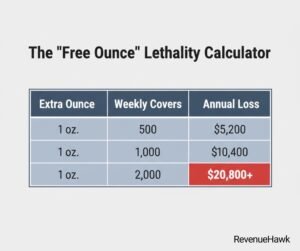
Wholesale prices will rise and fall. That’s out of your hands. Portions aren’t. One thing is certain, you can’t control the market, but you can control the plate. The National Restaurant Association’s latest food-cost indicator shows how uneven commodity moves were through 2025, with some items up while others dropped hard. That volatility makes portion drift even more dangerous: when costs jump, your free extra ounce goes from annoying to lethal.
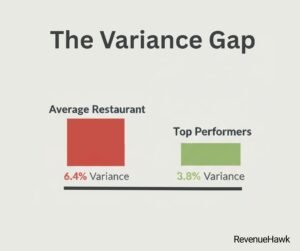
RevenueHawk Insight: Our 2025 analysis across fast casual and casual dining found a 6.4% median plate cost variance—what the recipe says it should cost vs. what it really costs once humans portion it. The best operators kept it under 3.8%. Not with pressure. With five standardized systems that work together.
And, your cooks aren’t the problem. They care. They want every guest to leave satisfied. Over-portioning almost never comes from laziness — it comes from broken systems: unclear builds, poor tools, rushed prep, sloppy par levels, and zero quick feedback.
Want a clear read on where food prices might head in 2026? Start with the USDA’s food price outlook.

KEY POINTS: WHAT YOU’LL LEARN
- Step-by-step how to stop over-portioning: The 5 systems we install so portion drift becomes rare (and obvious when it happens).
- Why this matters: Why inflation and value pressure makes over-portioning a silent profit killer in 2026.
- Case study: How a casual-dining brand unit fixed plate costs without shrinking guest satisfaction.
- The mistakes: Five blunt truths that stop teams from wasting time on the wrong fixes.
- The metrics: Simple formulas that tell you if portioning is improving this week, not next quarter.
- How to make It last: The minimum routines that keep the gains even when you’re short-staffed.
- The reset you need: Portioning is not discipline — it’s design.
- What to Do Next: A 30-day schedule to lock this in with your chef, and prep leads.
(And if you want one practical framework to keep near the office door, build your weekly rhythm around a 15-point weekly food-cost audit.
WHY THIS MATTERS
Menu prices are still rising, but guests are more sensitive than they look. According to FRED (Federal Reserve Bank of St. Louis), the food away from home index continued to rise in 2025, and full-service menu price inflation was still running meaningfully higher than falling food at home prices reported by the U.S. Bureau of Labor Statistics (BLS).
So operators are stuck in a squeeze:
- Costs move (sometimes fast).
- Guests demand value — brands like Chili’s and Texas Roadhouse are winning because they look like a good deal, even when pricing is tight.
- And if you raise prices, you’re walking a line.
So portion control has changed. It’s not just a kitchen cleanliness thing. It’s one of the few levers left to grow profit without poking the guest.
Traditional solutions fail because they’re backwards:
- “Negotiate harder.” Helpful, but it doesn’t stop line drift.
- “Do inventory once a month.” Too slow.
- “Talk to the team.” Talks don’t beat habits.
What operators are missing is the speed of feedback. The problem is that portion drift doesn’t show up on your P&L until weeks later — and by then it’s a blame game. You need a food-cost spike firewall — a system that catches problems inside 7 days, not 30.
s usually not one big thing — it’s usually a bunch of hidden leaks and profit killers adding up.
STEP-BY-STEP: HOW TO DO RESTAURANT PORTION CONTROL THE RIGHT WAY
To stop over-portioning and lock plate costs, we use a 5-step system build: (Step 1) define the plate with real recipe costs, (Step 2) make correct portioning the easiest move on the line, (Step 3) control prep so the line isn’t “freestyling,” (Step 4) track inventory/waste like a heartbeat, and (Step 5) redesign pricing and the menu so you’re not fighting math.
How to define the plate so there’s no interpretation?
We see a lot of restaurants having a definition problem. If your build is 6oz chicken but nobody has a scoop, a scale, or a photo standard, that’s not a spec. That’s nothing more than a suggestion.
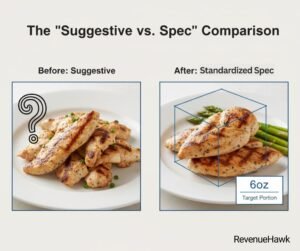
How do you fix this? You fix it with a recipe-costing playbook. Don’t just cost it once. Cost it like you mean it:
- One recipe card, one yield test, one portion spec.
- Photos of the plate from the expo view.
- A build map that shows what goes on first, second, last.
RevenueHawk insight: when restaurants finally cost recipes accurately, they usually find 3–7 items that look profitable but are secretly bleeding because the portion spec was never real.
How to make correct portioning the default on the line?
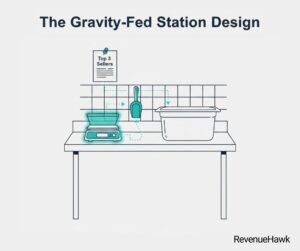
Most restaurant lines follow gravity. If the easiest move is to grab a handful, that’s what happens during a rush.
This is where most operators waste time. They try to train harder, but that rarely yields meaningful results.
Instead, we tell operators to install a weekly food-cost tracking routine so portion drift gets measured fast, and to redesign the station so the right portion is automatic:
- Pre-portioned proteins for peak periods (not all day — just when you’re slammed).
- Portion tools physically attached to pans (no hunting).
- Scales where they’re actually used (not buried under towels).
- A 10-second portion check at lineup for the top 3 sellers.
How to control prep so the line doesn’t freestyle?
Over-portioning often starts in prep. And if the prep cook rounds up, the line usually follows.
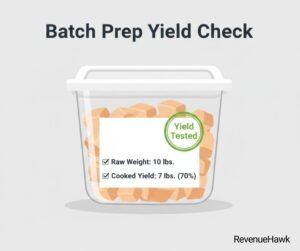
We advise operators to install a batch-prep system. This is not just about making everything ahead. It’s about standardizing the parts that cause chaos:
- Batch proteins into labeled containers with exact yields.
- Sauce and dressing batches with yield checks.
- Par sheets that reflect reality, not hope.
When batch prep is standardized, you should expent two things to happen at once:
- portions should tighten, and
- labor should get calmer because the line stops making it up mid-service.
How to track inventory and waste daily without turning it into a big project?
Monthly inventory doesn’t control anything — it just reports the damage. That’s like weighing yourself once a month and expecting to stay in shape.
So, you want daily inventory habits like these:
- A daily “top 10” count (your highest-dollar items).
- Waste log that takes under 3 minutes per shift.
- A receiving checklist so weights and counts match what you pay for.
- A usage check for the two items most likely to be over-portioned.
How to stop the invisible losses that make portions drift again?
We’ve seen what happens when shrink isn’t handled: the kitchen starts helping by over-portioning and making sloppy substitutions to cover shortages.
That’s why you need a waste-theft-shrink lockdown. No paranoia — just clarity:
- Lock and log the highest-cost items.
- Separate “waste” vs “comp” vs “mistake.”
- Close the loop: if an item is wasted, the recipe and prep process get reviewed.
In its 2026 outlook, Modern Restaurant Management shares expert predictions on how tech will help operators track portioning and prep accuracy without adding labor.
CASE STUDY: MEXICAN GRILL CHAIN
Restaurant Type
Casual dining
Location
Southeast U.S.
Seats
210
Problem Identified
Protein portions drifting and inconsistent prep yields.
What Was Implemented
- Station redesign
- Weekly feedback loop
- Vendor/spec cleanup
Results
Plate costs stabilized, comps dropped, guest scores held steady.
What Happened
This unit was doing fine on paper, but their steak and chicken items were quietly drifting. Not because people didn’t care — because the builds were interpreted differently by shift.
Started with plate standards and recipe yields, then tightened receiving and vendor specs. The biggest unlock was training managers to have vendor conversations using real numbers. Used supplier negotiation tactics to push for consistent trim specs and pack sizes — because portion control is impossible when product arrives inconsistent.
The output wasn’t magic. It was boring but it worked:
- Portion tools never moved.
- Prep yields were tested weekly.
- Top 10 items were counted daily.
- The chef stopped giving pep talks and started redesigning the system.
KEY MISTAKES: WHAT TO AVOID
Here are some of the mistakes we see operators make most often.
1. Telling people to just portion better.
If it’s not clear and easy, it won’t happen.
2. Only checking cost once a month.
By then, it’s too late to fix.
3. No photo, no tool, no weight.
Not a standard. Just a guess. Everyone will do it their own way.
4. Keeping low-margin items because regulars like it.
Liking it doesn’t change the math. You should cut-the-low-margin-losers.
5. Ignoring prep yields.
The line will fix it with extra food every shift, because nobody wants complaints.
METRICS: THE NUMBERS THAT MATTER
Here are the simple formulas we use in every portion-control audit:
Food Cost %
Food Cost % = COGS / Food Sales
Prime Cost %
Prime Cost % = (COGS + Labor) / Sales
Plate Cost
Plate Cost = Sum of (ingredient unit cost × portion size)
Portion Variance %
Portion Variance % = (Actual plate cost − Standard plate cost) / Standard plate cost
The “Free Ounce” Cost
The “Free Ounce” Cost = Extra ounces per plate × unit cost × weekly units sold
Pricing matters, too. If the price is wrong, you can do everything else right and still lose money. The 28% menu pricing formula helps keep your menu prices realistic — because perfect portions won’t fix a bad price. (Want more context on menu pricing? The National Restaurant Association outlines recent menu price trends and what’s driving them in a recent article.)
And don’t forget drinks. Good beverage controls often fund your food cost variations. Use beverage cost math and track:
- Pour cost
- Spill/comp rate
- Cocktail spec adherence
HOW TO MAKE IT LAST (THE CONSISTENCY CHECKLIST)
If you want this to last through callouts, rushes, and staff turnover, you need a few non-negotiables:
- Portion tools are assigned to stations (and replaced when broken)
- Photo standards are visible at expo and on the line
- Top 10 inventory count happens daily
- Waste is logged every shift (3 minutes, no excuses)
- One manager runs one plate check per day (two plates, two minutes)
- Weekly recipe yield spot-check on top 5 sellers
- Menu review monthly using menu engineering basics
QSR Magazine offers some practical angles on reducing food waste.
THE RESET YOU NEED
Start treating portioning like product design — not a kitchen discipline issue.
Because if you build the plan, the tools, the prep, the counting, and the check-ins the right way, your team doesn’t have to guess. They just do it — and it works.
That’s also why just making everything smaller is not the answer. The answer is high-profit dish design: build dishes that feel generous because they’re smart, not because you’re dumping expensive product.
ACTION PLAN: WHAT TO DO NEXT
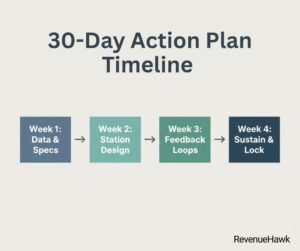
Fix this over the next 30 days as follows: (Week 1) prepare the data and lock recipe costs and photo builds, (Week 2) redesign stations and portion tools, (Week 3) create the feedback loop, and (Week 4) sustain the loop and lock margin without scaring guests.
How to prepare the data?
Pick your top 20 items by sales. Cost them. Photograph them. Define the exact build. No guessing.
How to redesign stations and standardize the line fast?
Set up stations so the right portion is the easiest move. The right tools, in the right place, with the right prep containers — and a 10-second check.
How to create the feedback loop?
Run weekly food cost tracking. Count top 10 daily. Waste log every shift. If numbers move, you see it inside 7 days.
How to lock margin without scaring guests?
Tighten the menu mix, fix pricing, and communicate value. If you need price moves, use price raises without backlash — because random price hikes without a value story are how you lose regulars.
FREQUENTLY ASKED QUESTIONS (FAQ)
1) Should we just shrink portion sizes?
Only if your portions are truly oversized and your value story supports it. Most of the time, you don’t need smaller plates — you need consistent plates.
2) What if cooks hate using scales?
Then the station is wrong. A scale is not the goal. The goal is speed and consistency. Sometimes that’s a scoop. Sometimes it’s pre-portioning during prep. Sometimes it’s a scale for only one high-cost item.
3) How fast will we see results?
If you track weekly, you’ll usually see variance tighten inside 1–2 weeks. If you track monthly, you’ll argue about it for 60 days.
4) Is beverage control worth doing if our problem is food?
Yes, because beverage margin is often your shock absorber. That’s why we pair food fixes with beverage cost math — it helps stabilize overall profit when food costs spike.
FINAL THOUGHTS
So you learned that over-portioning is the most expensive way to be nice to customers. And you’re not helping customers — you’re simply creating chaos.
What we’ve seen again and again is that the winners aren’t the restaurants with the strictest managers. The long-time winners are the restaurants with the best-designed system — where the right portion happens because the station makes it happen.
And the plays you’ve seen here so far are just a small part of our Restaurant Growth Engine system. We don’t fix one leak — we tune the whole machine so profit shows up every week, not just on a year-end P&L.