

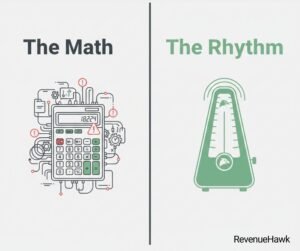
Did you know that most high food cost problems in your restaurant aren’t math problems? They’re rhythm problems: bad prep, late ordering, sloppy portions, rushed tickets. Learn how to track weekly restaurant food cost, fix the rhythm, and your margins will follow.
In our RevenueHawk audits, the restaurants that win don’t have the fanciest tech. They have a weekly close that never moves, a short list of money items they count every time, and a simple way to explain any gap. The rest is just noise — distractions that don’t move the number.
If you want the bigger picture and the full playbook that sits behind this weekly method, start with our food cost optimization guide.
RevenueHawk Insight: After reviewing tons of restaurants, we’ve seen a very clear pattern: when operators counted the same top 20 items every week, food-cost volatility dropped fast — usually within 3–5 weeks — because the team stopped getting blindsided at month-end.

KEY POINTS: WHAT YOU’LL LEARN
- Step-by-step how to track weekly restaurant food cost: A weekly tracking rhythm you can run with a clipboard and spreadsheet.
- Why this matters: What’s changing that makes sloppy tracking expensive.
- Case study: An example based on franchise-style operations (simple, real-world numbers).
- Mistakes: The 5 traps that make owners blame inflation for controllable issues.
- Metrics: The formulas that keep the team honest.
- Make it last: How to turn a one-time cleanup into a weekly habit.
- The reset you need: The belief shift that stops food cost from creeping back.
- Action plan: A 30-day rollout that won’t burn out your managers.
WHY THIS MATTERS
Look, food costs aren’t just high anymore — they’re volatile. And when costs move, restaurants with weak tracking get whiplash.
The USDA’s latest Food Price Outlook shows that food-away-from-home prices are rising faster than historical averages. While that sounds like more revenue, the reality is a margin squeeze. Your invoices for core categories like beef, veal, and beverages are creeping upward even faster, meaning your price hikes are often swallowed by rising input costs before they hit the bottom line.
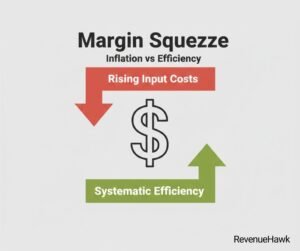
Operators are already feeling the heat. Restaurant Business report captured the mood as more brands realized they had to choose between absorbing these volatile costs or testing the limits of guest loyalty with another price hike. The data proves it wasn’t just a feeling — Black Box Intelligence flagged that menu price inflation remained persistent through the end of last year. This happened exactly when many kitchens felt like things had stabilized, yet their margins continued to shrink because the gap between what they were charging and the cost of their ingredients.
The major players already know how to survive this environment: they tighten portion control, simplify prep, and standardize purchasing. They don’t just raise prices; they manage the efficiency of the food they’ve already bought. Weekly tracking is the cheapest software option you can install in your building.
However, the common fixes operators try are usually wrong:
- Don’t buy cheap substitutes.
- Don’t just yell at the kitchen staff.
We often see that these moves don’t fix food cost — they just break guest love and kill staff morale. If you want to know where the line is on value and portion size this year, McKinsey’s consumer report shows it.
If you want to protect your margins without sacrificing your brand, you have to look at the system underneath. Start by identifying the hidden food-cost killers — the ones that never show up on an invoice until it’s too late.
STEP-BY-STEP: HOW TO TRACK WEEKLY RESTAURANT FOOD COST
To track weekly food cost without pricey software, we use a 6-step rhythm: (Step 1) lock a weekly close time, (Step 2) capture all purchases cleanly, (Step 3) count a short list of money items, (Step 4) calculate COGS the same way every week, (Step 5) compare actual vs theoretical to find the gap, and (Step 6) fix the gap in a specific order so you don’t chase ghosts.
How to lock a weekly close that doesn’t collapse?
Pick a close window and protect it like payroll. Same day. Same time. Same person accountable.
Here’s the problem we see all the time: most restaurants fail because they do it when they can. That turns tracking into a guess — and guesses can get expensive.
Use a simple rule: counts happen before ordering, not after. You want your order to be a decision based on reality, not a guess.
This is also where you can use the 15-point weekly food-cost checklist. Not because you’re a checklist person — because the restaurants that win don’t rely on motivation. They rely on a repeatable system.
RevenueHawk Insight: In our dataset, the fastest improvements came when managers had a 30-minute close ritual every week (counts, invoice stack and one spreadsheet update). The slowest improvements came from restaurants doing a perfect monthly inventory and ignoring 3 weeks of drift.
How to capture purchases without getting lost in invoices?
Stop spreading purchases across texts, emails, and random folders. Put them in one place.
Create a simple weekly purchases log:
- Vendor
- Date received
- Total
- Category (protein, produce, dry goods, dairy, beverage)
- Notes (credits, substitutions, anomalies)
Your job isn’t to make it pretty. Your job is to make it complete.
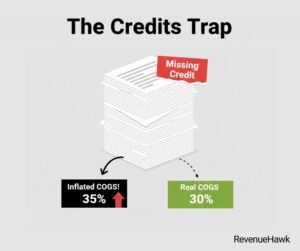
Now the important part: vendor credits and mis-picks. Most restaurants track invoices but ignore credits until the statement shows up weeks later. That makes weekly COGS look worse than it is — so you try to fix a problem you don’t actually have.
If you want food cost down, don’t just negotiate price. Negotiate the rules: billing accuracy, substitutions, and how fast credits hit. We laid it out in our supplier negotiation playbook.
How to count inventory weekly without counting everything?
Count dollars, not items.
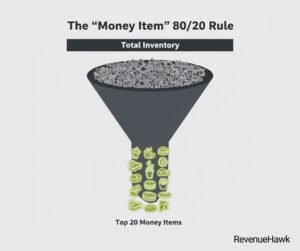
Weekly inventory should be an 80/20 count:
- Your top 15–25 items by spend (proteins, cheese, cooking oil, key sauces)
- High-theft items (steaks, shrimp, liquor if you’re including bar)
- High-waste items (greens, berries, avocados, bread)
Everything else can be monthly. And, this is the no software cheat code: a short count you actually do beats a full count you never do.
And yes — this is where portion control shows up. If your count says you should have 18 lbs of chicken and you have 6, the issue isn’t inventory. It’s execution. That’s why you implement anti over-portioning systems before you blame pricing.
How to calculate weekly COGS the same way every time?
Weekly COGS is simple if you stop overthinking it:
COGS = Beginning Inventory + Purchases − Ending Inventory − Credits
That’s it. Same formula weekly.
The trap is beginning inventory. If you’re starting fresh, your first week will be messy. Fine — start anyway. After week 3, it stabilizes because your beginning inventory becomes last week’s ending inventory.
Now attach sales. You can pull food sales from POS, or If your POS doesn’t break out food vs beverage, do it manually once, then set a rule.
How to find the real reason food cost is off?
Weekly food cost % tells you what happened. The gap tells you why.
You need two numbers:
- Actual Food Cost % (from inventory and purchases)
- Theoretical Food Cost % (from recipes and POS mix)
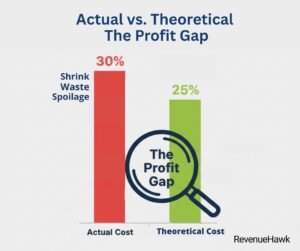
The difference between them is unexplained. That unexplained number is usually:
- over-portioning
- waste (prep, spoilage)
- comps/voids not rung properly
- theft/shrink
- recipe yield errors
This is where you tighten waste, theft and shrink lock-down. Not with cameras first, but by making sure the numbers force a story.
And if you want the simplest foundation for theoretical costing, build recipe costing step-by-step. You don’t need every recipe on day one. Start with your top 10 sellers and your top 10 cost drivers.
How to fix the gap without starting a hundred projects?
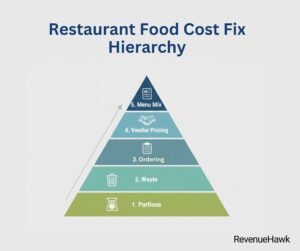
You should fix in this order:
- Portion control (this is the fastest win)
- Waste at prep (bad batch sizes, bad labeling, bad cooling)
- Ordering cadence (too much, too early)
- Vendor price sanity (contract vs invoice)
- Menu mix (you’re selling the wrong stuff)
This is also why batch cooking is either your best friend or your worst enemy. Batch-prep done right reduces both labor chaos and food loss. If done wrong, you just throw away larger quantities faster.
And when the weekly report catches a spike, you don’t panic — you just run the RevenueHawk restaurant cost spike-fix protocol. Remember, spikes are rarely a random event. They’re usually one of the following: a missed invoice, a wrong price, a big event buy, a prep blowup, or theft.
CASE STUDY: A REAL EXAMPLE — QSR FRANCHISE-STYLE OPERATION
Restaurant Type
QSR burger and breakfast (franchise-style, high volume)
Location
Suburban U.S. (standalone)
Seats
96
Problem Identified
Reported food cost jumped from 30% to 35% in 4 weeks, while sales stayed flat.
What Was Implemented
- Weekly 20-item money count (proteins, cheese, oil, fries, buns, breakfast meats)
- Invoice log with credit tracking
- Portion calibration cards at prep stations
- Top-10 recipe theoretical costing to compare vs actual
Results
- Week 2: Found two vendor price changes that weren’t noticed (unit cost up 8–12% on two core items)
- Week 3: Found chronic over-portioning on one signature sandwich build (average +0.6 oz protein)
- Week 5: Actual food cost stabilized at 31.2% without changing menu price; theoretical-to-actual gap shrank by 2.5 percentage points
The big win for the team wasn’t tracking — it was clarity. Once they saw the gap every week, behavior changed fast.
KEY MISTAKES: WHAT TO AVOID
1. Waiting a full month to count inventory.
If you only do monthly inventory, you’re running your business on a 30-day delay.
2. Not checking portions in real time.
If you trust the recipe but never weigh portions during service, you don’t have recipes—you have suggestions.
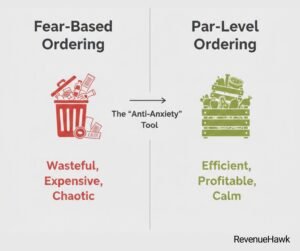
3. Ordering to avoid anxiety instead of using par levels.
If your ordering is based on fear (“what if we run out?”), your walk-in becomes a trash can.
4. Ignoring credits in your cost picture.
If you treat vendor credits as accounting, you will overstate COGS and make dumb cuts.
5. Cutting quality before fixing waste and execution.
And one more that hurts: keeping low-margin items because some people like it. That’s how you bleed profit. You need to cut low-margin menu losers or they’ll quietly eat your profit all week long.
METRICS: THE NUMBERS THAT MATTER
Here are the only formulas your weekly sheet needs:
Food Cost % (Actual)
Food Cost % = COGS / Food Sales
COGS (Weekly)
COGS = Beginning Inventory + Purchases − Ending Inventory − Credits
Inventory Turn (Weekly, simple version)
Turns = COGS / Average Inventory Value
Average Inventory Value = (Beginning + Ending) / 2
Theoretical Food Cost % (Top sellers first)
Theoretical Cost = Sum (Portion Cost × Items Sold)
Theoretical Food Cost % = Theoretical Cost / Food Sales
Prime Cost % (context)
Prime Cost % = (COGS + Labor) / Sales
Now, pricing ties directly to this. If you target a specific food cost number, you need a rule you follow. That’s why we suggest the 28% target pricing formula and then back into portion and price from there.
Also: never ignore beverages. It’s the easiest margin, and most operators under-measure it — we see it constantly. Add a separate line for bar/non-alcoholic beverages and track beverage cost % using a cheat sheet, so liquor doesn’t “hide” inside food variance.
Check NRN’s note for a quick read on how menu prices accelerated in late 2025 and into 2026. It summarizes the CPI-driven reality and could be helpful when you’re deciding how aggressive to be. Or, you can go straight to the U.S Bureau of Labor Statistics (BLS) CPI release PDF.
HOW TO MAKE IT LAST
Here’s the weekly consistency checklist that makes the math actually work:
- Same close day/time every week
- Same money item count list every week
- Purchases logged within 24 hours of delivery
- Credits recorded the day they’re confirmed
- One weekly variance story written in plain English (“Protein spike due to catering and price change”)
- One corrective action chosen (not five)
This is also where you need the five daily inventory habits. When you do the small stuff every day, the weekly numbers make sense — and you don’t fight about them.
RevenueHawk Insight: The restaurants that keep food cost stable long-term don’t work harder. They reduce decision points — fewer vendors, tighter pars, fewer menu items that require rare ingredients, and zero special cases that bypass the system.
And when you’re redesigning dishes, don’t just cut portions. Redesign the plate not only protecting margin, but also keeping guests happy. Learn how to design high-profit dishes without sacrificing quality.
THE RESET YOU NEED
- Food cost isn’t a percentage problem. It’s a process problem.
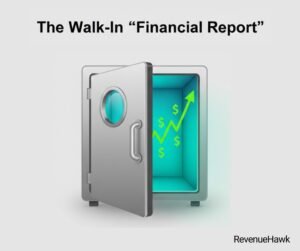
- Think of your walk-in not just as storage. Think of it as a live financial report.
- Your goal isn’t lower food cost. Your goal is predictable food cost.
And when you’re ready to go beyond tracking into making the menu start generating more money for you, start with menu engineering basics. Tracking tells you what’s happening; menu engineering changes what happens next.
ACTION PLAN: WHAT TO DO NEXT
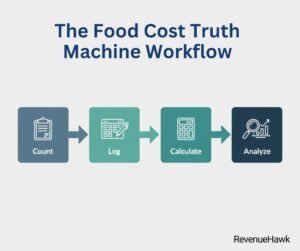
Run this over the next 30 days as follows: (Week 1) prepare your data and lock the weekly close, (Week 2) build your money-item count and purchasing log, (Week 3) add theoretical costing for top sellers and tighten portions, and (Week 4) clean up the menu and pricing decisions and train the team to sustain it.
How to prepare my data?
Pull the last 4 weeks of:
- Food purchases (invoices totals)
- Food sales (POS)
- Any inventory counts you already have (even if messy)
Build the spreadsheet with the formulas from the Metrics section. Don’t aim for perfection. Aim to be able to run it every Monday.
How to build my weekly count and purchasing log?
Choose the 20 items that drive your spend. If you don’t know, it’s almost always:
- proteins
- cheese
- oil
- key starches (rice, pasta, fries)
- bread/buns
- one or two high-cost sauces or dessert bases
Set pars, who counts and where counts are written. Remove friction.
How to add theoretical costing and portion control without slowing service?
Cost your top 10 sellers first. Weigh portions during one slow shift and one busy shift. Don’t debate the results.
Then implement two controls:
- portion tools (scales, ladles, scoops)
- line checks (one manager spot-check per shift)
This is where we see most operators get scared about guest pushback. If you’re currently over-portioning, standardizing rarely hurts ratings — it usually improves consistency.
How to clean up menu and pricing and lock the system in?
Now you make the decisions that matter — and you make them smart:
- Drop items that require weird ingredients or low velocity
- Reprice items that can’t hit your target food cost
- Train new hires on build standards immediately
When you have to raise prices, do it smart. Use proven tactics to avoid losing customers and pair it with a clear value story (bundle, portion clarity, quality cue, limited-time framing).
If you want to know what guests will call “value” in 2026, read the National Restaurant Association’s trends piece on where menus are headed.
FREQUENTLY ASKED QUESTIONS (FAQ)
1) What if I can’t separate food sales and beverage sales?
Start with total sales, but add a simple weekly estimate using POS category mix (even if it’s rough). Within a month, you’ll have a stable split.
2) How long should weekly counting take?
If it’s taking more than 45 minutes, your count list is too big or your storage is too messy. Fix layout and label shelves. Shorten the list.
3) What if my food cost is “fine” but my profit is still bad?
Then food cost is a symptom, not the disease. Look at labor, comps/voids, discounting, menu mix, and scheduling.
4) Do I ever need software?
Maybe later. But software won’t fix missing credits, sloppy portions, or chaotic ordering. Earn the right to buy software by proving you can run the weekly rhythm first.
FINAL THOUGHTS
Here’s a key takeaway: even expensive software won’t save a restaurant that doesn’t tell the truth every week.
Weekly food cost tracking is you building a truth machine: same close, same count, same math, same questions, same fixes. Once you can see the gap weekly, you stop guessing, you stop overreacting, and you stop letting inflation be an excuse for preventable waste.
And zooming out: the plays here are just a small part of our Restaurant Growth Engine system — the real win is treating your restaurant like one connected machine, where menu, purchasing, prep, portions, and pricing all push the same direction.