
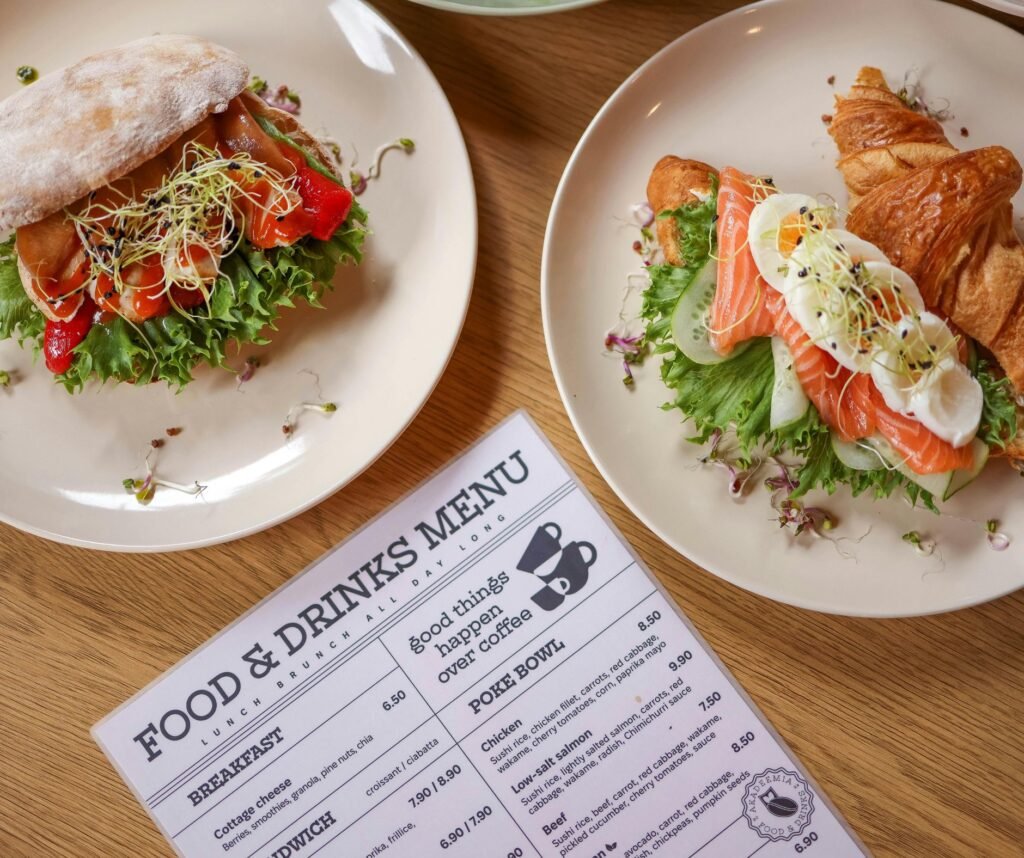
If your menu is messy, your profits will be too. You can’t expect high profit margins unless you aim to design a high-margin restaurant menu.
Across the RevenueHawk platform, when we looked at thousands of restaurants with margin problems, the pattern was clear but brutal: the worst performers almost always had bloated menus, fuzzy recipe costs, and zero real menu engineering. When those same operators cleaned up their menu, average profit per cover jumped 10–18% — without adding a single new guest.
And in 2026, you don’t have much choice. According to the National Restaurant Association (NRA) food input costs are still way above pre-2020 levels; the Producer Price Index for “all foods” is about 37% above February 2020. Based on Federal Reserve Bank of St. Louis (FRED) data menu prices have already risen roughly 31% since 2020 just to keep the typical 5% profit margin alive. Guests feel that, and they’re watching every dollar.
So if you keep treating your menu like a creative playground instead of a profit engine, you’re going to get crushed by operators who don’t — and who are highly committed to design a high-margin restaurant menu.
That’s why we push every client to build food-cost control inside their business — a single system where menu design, costing, purchasing, and pricing all talk to each other in real time.
On top of that, the winners are obsessed with hunting down a hidden food-cost killers. They don’t just ask “what’s my food cost?” — they ask “which item is silently robbing me tonight?”

KEY POINTS: WHAT YOU’LL LEARN
- Step-by-step guide: A simple, mechanical way to engineer your menu using real numbers, not vibes.
- Why this matters: How menu engineering protects you from inflation, traffic swings, and delivery commissions.
- Case study: A 90-seat grill concept that cut SKUs by 22% and added 4.5 points of margin in 90 days.
- Key Mistakes: The classic errors that keep food cost high even when you “watch waste.”.
- Key metrics: The handful of formulas you actually need to run a high-margin menu.
- Make it last: How to turn menu engineering from a one-time project into a weekly habit.
- The reset you need: The mindset shift from “more dishes = more sales” to “fewer, better, more profitable dishes.”
- Action plan: A 14-day playbook you can actually follow while running service.
WHY THIS MATTERS
Two things are happening at the same time:
- Costs are structurally higher.
According to the USDA ERS, food away from home continues to rise and is expected to increase by an average of 4.6% in 2026, while groceries are expected to rise by only 1.7% on average. Guests notice that eating out is the more expensive option now. - Traffic is fragile.
NRA’s “State of the Industry” (SOI-2025) document 10+ months of net traffic declines through late 2025, with off-premise (takeout/delivery) sustaining sales amid dine-in weakness.
Big brands are not guessing their way through this:
- Fast casual keeps winning, according to QSR report, by focusing on tight menus, high-margin add-ons, and simple builds
- In Modern Restaurant Management’s 2026 outlook, operators talk openly about tweaking menu pricing and kitchen efficiency to keep up with labor and food inflation.
What most independent operators still do:
- Raise prices randomly when the invoice hurts
- Add “fun new dishes” without costing them
- Keep low-margin fan favorites out of fear
- Look at overall food cost once a month and panic
That doesn’t work anymore. Instead, you need:
- A weekly food-cost audit routine (The Restaurant Food Cost Audit: A 15-Point Weekly Checklist)
- A clear menu pricing formula baked into every new dish
RevenueHawk Insight: Across the thousands of restaurants in our database, operators who ran a structured weekly food-cost review and re-priced just 3–5 items per month saw an average 3.6-point improvement in prime cost within 90 days. No extra marketing. No extra covers.
Copying discounts and promos from the big brands is a waste of time. But using strategies to build a menu that actually earns a profit at today’s cost levels is the only game that matters.
STEP-BY-STEP HOW TO DESIGN A HIGH-MARGIN RESTAURANT MENU
Think of this as installing a system, not doing a one-time menu cleanup.
Step 1: Get Real Recipe Costs
You can’t engineer what you haven’t actually costed.
- Pull your last 4–6 weeks of purchase invoices
- List exact ingredients, pack sizes, and net unit cost
- Cost out your top 20 selling items first, then the rest
This is where you build an accurate recipe costing process. Until every ingredient and yield is in there, your menu prices are nothing more than guesses.
RevenueHawk Insight: in our data, restaurants that fully documented recipes ended up discovering that 12–18% of their menu items were priced below their theoretical food cost target. Those items weren’t slow sellers — they were land mines.
Step 2: Fix Portions and Plate Standards
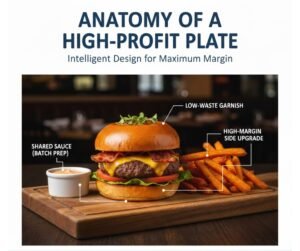
Once you know your true cost per dish, you should lock in portions.
- Standardize plating photos
- Use scoops, ladles, and scales
- Train line cooks using actual plate-cost targets
You’re building an accurate portioning systems. “A little extra chicken” on a busy Friday can destroy thousands in margin over a year.
Step 3: Track Food Cost Weekly (Not Just Monthly)
Now that your costs and portions are real, put in a simple weekly food-cost tracking system in place:
- Start and end the week with quick, focused inventory counts on key items
- Add purchases, subtract ending inventory, divide by weekly food sales
- Use a simple sheet or your POS exports — tools matter less than consistency
The operators we see winning aren’t necessarily the ones with the fanciest software. They’re the ones who actually look at the numbers every single week.
MRM has a helpful overview how operators are using tech and data to build resilient operations.

Step 4: Design for Batch Prep and Labor Efficiency
Menu engineering is not just about margins — it’s also about throughput.
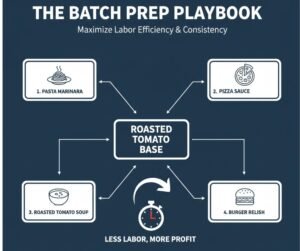
Design dishes and mise so you have a batch-prep playbook:
- Group menu items by shared components (sauces, bases, garnishes)
- Batch-prep high-use items during off-peak hours
- Use those components across multiple high-margin dishes
When we modeled labor productivity on our platform, restaurants that consolidated SKUs and batch-prepped intelligently served 14% more guests per labor hour than those with dishes that shared nothing.
Step 5: Engineer Prices with Psychology, Not Panic
This is where we see most operators either freeze or do something random like adding +10% across the board.
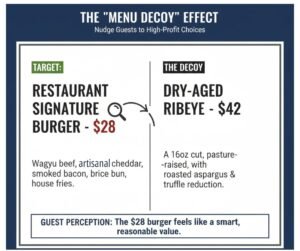
Instead, build a pricing psychology toolkit:
- Move high-margin “stars” to high-visibility zones on the menu
- Use decoy items (slightly higher-priced anchors) to make profitable choices feel reasonable
- Nudge guests toward profitable bundles (entrée, side and beverage)
- Test small, targeted increases on items with strong demand before touching fragile items
Here’s more from QSR on a breakdown of menu pricing psychology.
Remember: pricing is not about squeezing guests. It’s about charging enough that you can keep delivering the quality and experience they actually came for.
CASE STUDY: A REAL EXAMPLE
Restaurant Type
Casual grill (mainly burgers, sandwiches, and salads)
Location
Urban neighborhood
Seats
90
Problem Identified
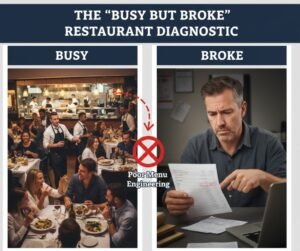
Food cost stuck at 35–36%, even with steady traffic. This operator: “We’re busy but broke.”
What Was Found
- 64 menu items
- No accurate recipe costing
- No structured way to respond to sudden supplier price hikes
- Lots of emotional attachment to low-margin “favorites”
What Was Implemented
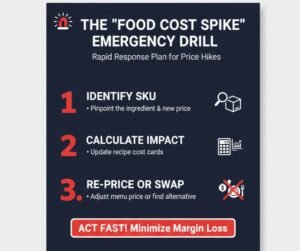
Built a food cost spike emergency drill (How to Fix Sudden Food Cost Spikes (And Prevent Them Forever)):
- Weekly 30-minute meeting: review top SKUs whose cost moved >5%
- Quick decision rules: “re-price, re-engineer, or replace” within 7 days
- Live menu spreadsheet tied to updated ingredient costs
Then ran a kill-the-losers review:
- Sorted items by contribution margin, not just sales
- Flagged 11 dishes with high volume but terrible margin
- Kept only 3 of them and rebuilt pricing/recipes; cut the rest
Results in 90 Days
- Menu went from 64 to 50 items (-22%)
- Food cost dropped from ~35.5% to 31%
- Average check rose 9%
- Prime cost improved by 4.5 percentage points
KEY MISTAKES: WHAT TO AVOID
These are the mistakes we see all the time. They will usually kill your menu before the competition does:
1. Treating shrink and waste as “normal.”
You need a loss-prevention mindset — cameras and scolding are not enough. Track voids, comps, and spoilage like you track sales.
2. Ignoring supplier strategy.
If you don’t follow a supplier negotiation playbook, you’re paying “walk-in customer” prices in a wholesale world.
3. Building specials before fixing the core.
Launching a new LTO while your core menu is uncosted is like remodeling the patio while the kitchen is on fire.
4. Chasing every tech toy.
Buying software you won’t use is worse than using spreadsheets you will use. Tech should plug into your menu engineering process, not replace having one.
METRICS: THE NUMBERS THAT MATTER
You don’t need 50 KPIs. You need a handful you actually look at.
Food Cost %
Food Cost % = COGS / Food Sales
Target depends on style, but many full-service operators aim for 28–32%. Restaurant.operations data shows that operators who kept food-cost ratios in line did it mainly through streamlined menus and better off-premise strategy, not magic.
Labor Productivity
Labor Productivity = Covers / Labor Hours
Menu complexity hits this hard. More SKUs, more modifiers, more chaos.
Contribution Margin (per dish)
Contribution Margin = Selling Price – Cost per Dish
This is the real hero of menu engineering. You promote high contribution margin dishes; you fix or cut low ones.
Prime Cost %
Prime Cost % = (COGS + Labor) / Sales
We like to see this under 60% for most restaurants, lower if possible. McKinsey’s work on restaurant profitability keeps returning to the same point: profitable growth comes from integrated revenue management and cost control, not just chasing volume.
Throughput
Throughput = Guests Served per Hour per Station
Complicated menus murder throughput. Simple builds win.
Now add two routines most operators skip:
- A beverage-cost percentage drill — bar programs can quietly bleed margin.
- A daily inventory-habit loop — quick daily spot checks on key SKUs instead of one giant monthly count.
RevenueHawk Insight: restaurants on our platform that tracked prime cost weekly and ran even a basic beverage-cost review once a month ran, on average, 3–5 margin points ahead of peers who just glanced at a monthly P&L.
HOW TO MAKE IT LAST (TURN IT INTO A SYSTEM)
Menu engineering works only if it becomes boring. Here’s a simple checklist:
Weekly
-
- Run your food-cost report on key categories
- Review top 20 items by sales and by contribution margin
- Decide: re-price, re-engineer, or retire 1–3 items
Monthly
-
-
- Run one recipe engineering session with your chef and manager — tweak builds to improve margin without hurting perceived value.
- Review supplier prices, look for consolidation or renegotiation opportunities
-
Quarterly
-
- Re-layout your menu (placement, callouts, anchors) based on updated performance
- Decide which items become signature “stars” and which get phased out
THE RESET YOU NEED TO MAKE
Here’s the mindset upgrade:
- You don’t win by working harder — you win by removing chaos.
- Systems beat talent. A great chef without costing and menu rules is a very expensive hobby.
- Numbers beat guessing. “Feels popular” is not a metric.
- Consistency beats effort. A small weekly process will outperform a giant panic project every six months.
McKinsey calls this revenue growth management — aligning pricing, assortment, and promotions to unlock value (RGM). We just apply such thinking at the menu level, dish by dish.
ACTION PLAN (14-DAY SPRINT)
Day 1–2
Print 4–6 weeks of sales mix. Circle your top 20 items by sales. Those are your priority.
Day 3–5
Cost those 20 items properly using invoices. Lock in standard recipes and yields.
Day 6–7
Install basic portion controls on the line (scoops, scales, ladles). Take photos of ideal plating.
Day 8–9
Run your first weekly food-cost and prime-cost calculation. Don’t overthink; just get the baseline.
Day 10–11
Re-price 3–5 items using your food-cost target and basic pricing psychology (anchors, bundles, better placement).
Day 12–14
Kill or re-engineer 2–3 obvious losers. Announce “menu refresh” to staff and guests, not “price hike.”
FREQUENTLY ASKED QUESTIONS (FAQ)
Q1: Won’t cutting menu items upset regulars?
Some will complain for a week. Then they’ll order something else. What really upsets guests is when your quality drops because margins are too tight to maintain standards.
Q2: How often should I raise prices?
Small, targeted moves a few times a year beat big, scary hikes. Watch your costs monthly; adjust the right 3–5 items each quarter.
Q3: Do I need fancy software to do menu engineering?
No. A decent POS export, a spreadsheet, and discipline will get you 80% of the way. Software just makes it faster once the process exists.
Q4: Should I use dynamic pricing?
For most restaurants, classic airline-style dynamic pricing is more distraction than value. Focus first on understanding your unit economics; then decide if dynamic tools make sense for specific dayparts or channels. QSR report confirms that traditional dynamic pricing doesn’t work for most restaurants.
FINAL THOUGHTS
What we’ve learned over the years is that if your menu doesn’t work as a system, nothing else will save you. Not TikTok. Not delivery apps. Not another “brand refresh.”
Menu engineering is not about cute menu boxes and fonts. It’s about:
- Knowing exactly what each dish earns
- Making it stupid-easy for guests to choose the dishes that make you money
- Keeping your costs, suppliers, and recipes lined up with reality every single week
The plays here — costing dishes properly, cutting losers, engineering prices, and installing weekly rhythms — are just a small part of our broader Restaurant Growth Engine system. But if you actually implement just what’s in this article, your menu will stop being a mystery and start behaving like what it really is: A machine that either prints profit… or burns it.
Your job in 2026 is simple: make sure it’s the first one.