
What’s the restaurant pricing formula to hit a 28% food cost?
Most restaurants can’t achieve 28% because they don’t know their real plate costs, and they don’t have a system to stop costs from drifting every single week.
At RevenueHawk, we’ve audited thousands of menu items in real kitchens. The pattern is the same: operators who hit their target food cost aren’t smarter — they’re just more consistent. They use one pricing formula, they enforce it, and they stop letting chaos (portion creep, waste, vendor swings, and bad mix) price the menu for them.
If you want the full view, start with our food-cost optimization guide.
RevenueHawk Insight (from our platform data): In a 2025–2026 sample of menu items we costed end-to-end, 61% were priced worse their true 28% floor once we included invisible costs (oil, garnish, bread, sauces, staff meals, and comped sides). Owners thought they were at 28%. On paper, they were. In reality, they were at 31–35%. That gap alone is the difference between being busy and broke and busy and profitable.

KEY POINTS: WHAT YOU’LL LEARN
- Step-by-step how to get food cost under control: The exact pricing mechanism we use to land at 28%.
- Why this matters: What’s changing in 2026 that makes old pricing habits dangerous.
- Case Study: How a well-known brand’s pricing rethink mirrors what works at store level.
- Mistakes: Avoiding these stops owners from bleeding margin.
- Metrics: The only formulas you need to run pricing like a machine.
- Make it last: How to prevent drift (the silent killer of food cost).
- The reset you need: The belief shift that makes 28% realistic, not wishful.
- Action plan: A 30-day rollout you can actually execute.
WHY THIS MATTERS
Costs aren’t going back to normal. Even when inflation cools, volatility will most stay. And volatility punishes those restaurants that price once a year and just hope it works.
The National Restaurant Association’s 2026 outlook talks about ongoing cost and operating challenges. And according to a Restaurant Business report the industry is still expected to grow mostly on price, not traffic — which is a trap if your menu isn’t engineered for margin.
Menu prices have been climbing, but not evenly — and not always intelligently. The National Restaurant Association’s menu price tracker shows inflation is still firm heading into 2026. Meanwhile, official CPI reporting shows food-away-from-home prices up year-over-year, with full-service rising faster than limited service.
And ingredients aren’t stable. USDA ERS data shows food prices still rising year-over-year into 2026 as wholesale food prices remain well above per-pandemic levels.
Big brands already adapted. McDonald’s has been publicly chasing value again. Chipotle and fast casual leaders are balancing premium pricing with value anchors. Everyone is trying to protect traffic while costs stay annoying.
What independent operators keep missing is the systemic part: Your menu price isn’t just a number. It’s the output of your recipe costing, portion control, inventory discipline, purchasing power, prep system, and menu mix — all at once.
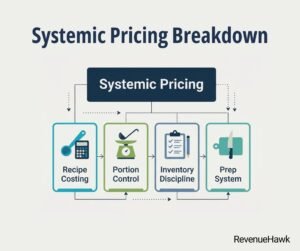
So if you’re sitting there asking yourself why you’re always high on food cost you’re usually dealing with a number of hidden food-cost profit killers — not one big obvious problem.
STEP-BY-STEP: HOW TO PRICE YOUR MENU FOR A 28% FOOD COST
To price your menu for a true 28% food cost, we use a 4-step audit: (Step 1) cost every recipe like you’re going to court, (Step 2) build a 28% price floor item-by-item, (Step 3) engineer the menu mix so the average stays on target, and (Step 4) lock the system with weekly controls so it doesn’t drift.
How to cost every recipe like you’re going to court?
One key problem we see all the time is that most recipe costs are fake. Not on purpose — just missing stuff.
Here’s the rule you want to follow: If it touches the plate, it gets costed. Oil. Salt. Sauce cup. Pickle spear. Garnish. Bread. That extra ounce of fries your line cook hooks up the guest with.
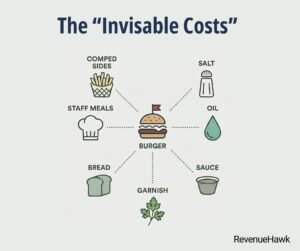
This is where following an accurate recipe costing playbook matters. You’re not doing this for perfection. You’re making sure your prices aren’t built on made-up math.
What we see in audits:
- Operators cost proteins, but not the supporting cast (sauces, sides, garnish).
- They use case cost / case weight once… then never update it.
- They ignore yield loss (trim, cook loss, peel loss).
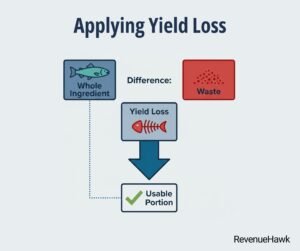
Here’s is a simple method that works:
- Convert everything to a usable unit (oz, grams, each).
- Apply yield where it matters (proteins, produce).
- Lock the recipe spec (exact weights).
- Update prices when invoices change (not when you feel like it).
If you only do one thing this week: cost your top 20 sellers properly. That alone usually reveals 80% of the food-cost leak.
How to build a 28% price floor (so every item can win)?
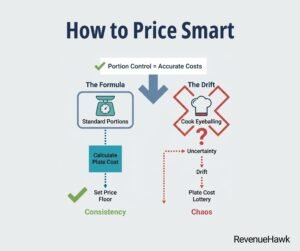
Once you have true plate cost, the pricing formula is embarrassingly simple:
Menu Price = Plate Cost / Target Food Cost %
If target is 28%:
- Plate cost $4.20: $4.20 / 0.28 = $15.00
- Plate cost $3.64: $3.64 / 0.28 = $13.00
That’s the math. The hard part is making plate cost behave. So, the fastest way to hit 28% isn’t raising prices. It’s stopping the drift caused by portion creep. You need to use stop-over-portioning systems.
Key point: If your cooks eyeball portions, you don’t have a food cost target — you have a food cost lottery.
Here’s what we’ve seen actually work in real kitchens:
- Pre-portion proteins.
- Use the same scoop/ladle every shift, every station.
- Build plating guides with photos.
- Spot-check plates during rush.
A 0.5 oz protein creep on a best-seller can erase your margin faster than any competitor.
How to engineer the menu mix so the average lands at 28%?
Here’s where most owners get it wrong: They price every item to 28% and still miss 28% overall.
This happens because guests don’t order evenly. They order what you push, what you feature, and what feels like a good deal.
So you need menu engineering basics to control what wins the popularity contest.
What you need to do in audits:
- Rank items by contribution margin (price – plate cost).
- Rank items by popularity (units sold).
- Identify the heroes (high margin, high popularity).
- Identify the traps (low margin and high popularity).
Then redesign:
- Placement on the menu (eyes go where you guide them).
- Bundles and add-ons (attach margin).
- Portion/recipe tweaks (raise margin without raising price).
- Value anchors (but you don’t lose money).
Your goal is not that every item hits 28%. Your goal is that your menu mix hits 28% while your best-sellers still feel like a good deal.
How to keep 28% from drifting week after week?
Pricing is not a one-time project — it’s a weekly system.
You need weekly food-cost tracking — because monthly is too late. Monthly is where you discover the fire after it burned the building.
Weekly tracking catches:
- Vendor price jumps
- Portion creep
- Theft and comps
- Prep waste
- Menu mix shifts
The idea here is not to make you do hard math all day. We just want you to spot problems early — so you don’t lose money for four weeks before you notice.
CASE STUDY: A SWEETGREEN-LIKE HEALTHY MEAL CHAIN
Restaurant Type
Fast-casual bowls/salads
Location
Major metro, high rent corridor
Seats
34
Problem Identified
Best-sellers were priced like traffic drivers but portion creep and prep waste made them margin killers.
What Was Implemented
- recipe engineering for high-profit dishes (kept the taste but adjusted the build)
- Removed the bottom performers using kill low-margin loser items
- Tightened prep flow with batch-prep systems that cut waste
Results
- Food cost stabilized within 2 weeks
- Margin improved without a blanket price hike
- Ticket time improved because prep got simpler (system effect: labor and food moved together)
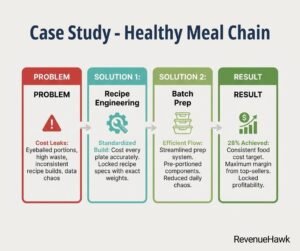
The takeaway: the win wasn’t just being able to charge more. The win was stopping cost leaks and making the menu mix pay you.
KEY MISTAKES
1. If you don’t control loss, pricing won’t save you.
If product walks out the back door, gets over-portioned, or gets tossed, your menu is just funding leaks. Build a waste/theft/shrink loss prevention system.
2. Vendor price hikes aren’t fate. You can plan for them and respond fast.
Yes, costs go up. But we see many operators never ask, never shop and never lock terms. We call this voluntary suffering.
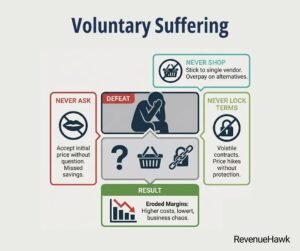
Use our supplier negotiation tactics to get the best prices and terms you can.
3. Spikes don’t just happen.
Sudden food cost spikes usually come from 3 things: invoice increases, portion creep, or inventory errors. Put in a sudden food-cost spike firewall so you catch it in days, not months.
4. Planning to raise prices later is how you lose a year.
By the time you feel the pain, you already ate it.
5. You can’t discount your way to 28%.
Remember, discounting hides broken economics. Fix the system first, then decide where value belongs.
Curious how restaurants are navigating tariffs, rising costs, and pricing pressure? Restaurant Dive lays out how operators are reacting and what that’s doing to margins and menu prices.
METRICS: THE NUMBERS THAT MATTER
You don’t need 40 KPIs. You need the right 8.
Food Cost %
Food Cost % = COGS / Food Sales
Target Plate Cost
Target Plate Cost = Menu Price × Target Food Cost %
Menu Price (to hit target)
Menu Price (to hit target) = Plate Cost / Target Food Cost %
Prime Cost % (context)
Prime Cost % = (COGS + Labor) / Sales
Contribution Margin (Item $)
Contribution Margin (Item $) = Menu Price − Plate Cost
Theoretical Food Cost
Theoretical Food Cost = What you should have used (based on recipes and sales)
Variance
Variance = Actual Usage – Theoretical Usage
Menu Mix Food Cost
Menu Mix Food Cost = Weighted average based on what guests actually order
And don’t ignore drinks. Beverage is where many restaurants quietly save the P&L. Build a beverage cost % calculator and track it like you track food. And if beverage cost is sloppy, the bar is stealing profit you already earned.
Also: inventory isn’t a once-a-month task. We’ve seen plenty of high-profit kitchens win with boring habits. Install these 5 daily inventory habits and lowering costs becomes almost automatic.
How consumers are behaving when prices stay top-of-mind? McKinsey’s 2025 consumer research shows price pressure remains a primary concern and drives trade-down behavior.
HOW TO MAKE IT LAST
What we’ve learned over the years: restaurants don’t fail from lack of knowledge. They fail because they can’t stay consistent long enough to win.
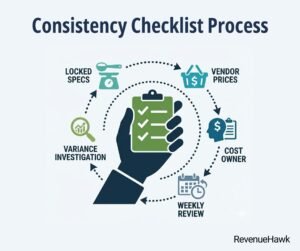
Here’s the consistency checklist we use to stop drift:
- Recipe specs are locked (no chef’s vibe portions)
- Vendor prices get updated on schedule
- One person owns recipe costing (single throat to choke)
- Weekly food cost is reviewed every week, same day
- Variance gets investigated, not ignored
- Menu changes run through a margin check before launch
- Prep pars are set and adjusted (no panic prep)
If you want a read on how guest price sensitivity is shifting, Modern Restaurant Management summarized 2025 survey data showing diners noticing higher prices and adjusting behavior.
THE RESET YOU NEED
If you want a 28% food cost, you have to stop thinking pricing is the easy way out when costs go up. Pricing is what you do because you have a system. And you need the confidence to raise prices the right way, not the lazy way. That’s where our smart price raises come in.
Remember: guests don’t get mad because you raised prices. They get mad because they feel played. Shrink the portion, cut the quality, and raise the price — trust is gone. Or, make the value clear, and most guests adjust.
If you want a straight writeup on cost pressure in 2025, QSR’s reporting captures the fight QSR operators have been living through.
ACTION PLAN: WHAT TO DO NEXT
Run this over the next 30 days as follows: (Week 1) cost and clean your data, (Week 2) set 28% price floors and fix portions, (Week 3) engineer the menu mix and remove losers, and (Week 4) lock weekly controls and retrain the team so the system survives.
How to cost and clean your restaurant data?
Pull these:
- Last 8 weeks of invoices
- Current recipes (even if messy)
- POS sales mix (units, not just dollars)
Cost your top sellers first. Don’t start with the entire menu if that slows you down. Speed beats perfection.
You can pull industry context: official CPI reporting gives you a reality check on how food-away-from-home pricing has been trending.
How to set price floors and fix portions?
For each top seller:
- Confirm recipe spec
- Confirm portion tools (scale, scoop, ladle)
- Calculate plate cost
- Calculate 28% menu price
Then decide:
- Raise price
- Adjust build (smart recipe engineering)
- Replace with a better-margin option
- Reduce portion waste
Don’t use emotion. Use math and brand standards.
How to engineer the menu mix and remove losers?
Do not change 30 items at once.
Pick:
- 5 items to feature harder (high margin, popular)
- 5 items to fix (popular but low margin)
- 3–5 items to cut (low margin, low popularity)
That’s enough to move the average.
How to lock weekly controls and retrain?
This is where it becomes real.
- Create a weekly cadence: 1) invoice updates; 2) theoretical vs actual check; 3) variance investigation.
- Retrain plating and prep with photos and tools
- Tie manager performance to controllables (variance, waste logs, portion compliance)
Do you want a broader pricing and tariff pressure view? Harvard Business School’s 2026 trend analysis frames why cost shocks often show up as gradual price pressure over time.
FREQUENTLY ASKED QUESTIONS (FAQ)
1) Is 28% food cost realistic for every restaurant?
No. But it is realistic for many concepts with strong portion control and engineered mix. If you’re a steakhouse with heavy commodity exposure, you may need a different target — or a different menu structure.
2) Should I price every item to exactly 28%?
No. Price to protect the brand and traffic, then engineer the mix so the average hits target.
3) What if my competitors are cheaper?
Then you must win on clarity: portion, quality, speed, experience, brand. Cheap competitors still go out of business when their economics are broken.
4) How often should I change menu prices?
As often as the inputs demand — but do it with guardrails. Many operators do small, smart adjustments quarterly and use weekly controls to spot issues early.
FINAL THOUGHTS
If you want 28% food cost, stop looking for a pricing hack. Your menu price is the output of your whole operation. If prep is sloppy, portions drift and inventory is loose — your pricing formula will fail, no matter how right the math is.
Build the system once, enforce it weekly and let competitors guess.
And remember: the plays here are just a small part of our Restaurant Growth Engine system — the bigger win is when your menu, kitchen, purchasing, and training all work together like one machine.