
If your dining room is packed but your bank account is empty, something’s off. So try to be honest: where is the money going?
In the last few years, we’ve watched the industry get squeezed. Guests have become more price-sensitive, and wholesale input costs remain volitile. According to the USDA’s January 2026 Food Price Outlook, retail beef and veal prices are projected to jump 9.4% this year.
And, while you are paying more for prime proteins, your ability to pass those costs on is hitting a ceiling. This creates a dangerous gap: Food-away-from-home prices (your menu prices) are forecast by USDA to rise by 4.6% in 2026 — if your ingredient costs rise faster than that, your margin is the only thing that shrinks.
So, loss prevention isn’t optional anymore. It’s the game. And if you don’t play it well, you lose.
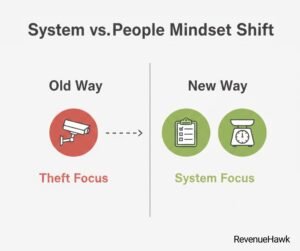
And the fastest way to win is to treat shrink like a system problem, not a people problem. Most restaurants jump straight to cameras and threats, which is a waste of time. The best operators build a machine where theft and waste become hard to do and very easy to spot.
We put together a guide on lowering food cost. It’s core message is simple: your kitchen is a money pipeline — and the leaks show up in the same places every time.

KEY POINTS: WHAT YOU’LL LEARN
- Step-by-step: how to do restaurant loss prevention the right way: A simple audit that turns “I think we have shrink” into proof and action.
- Why This Matters: The market pressure that makes waste and theft lethal in 2026.
- Case study: How a restaurant chain tightened controls and kept the culture healthy.
- Mistakes: The 5 key mistakes operators make when they try to stop the bleeding fast.
- Metrics: The formulas that catch shrink before it becomes a monthly surprise.
- How to Make It Last: Routines that keep your controls alive after the new system excitement fades.
- The Reset You Need: The mindset shift that separates operators who win from operators who vent.
- What to Do Next: A 30-day rollout that doesn’t overload your team.
WHY THIS MATTERS
Here’s one key thing to remember: more sales won’t save you. Better controls will.
Restaurant traffic has been unpredictable, and the industry is locked in a value war. A Restaurant Dive article shows it clearly how major brands leaned into aggressive price-point campaigns throughout 2025 to keep guests from trading down.
Meanwhile, the food-cost story hasn’t gone away. A Restaurant Dive 2025 operator survey found that most leaders are still reporting cost increases and expect the pressure to remain relentless through 2026.
The macro view confirms this squeeze: The USDA ERS forecasts that while food-away-from-home prices (what you charge) will continue to rise in 2026, guests are hitting a breaking point. When you can no longer hike prices to cover your margins, every ounce of waste is a direct hit to your bottom line.
Here’s what we see that operators miss: High food cost is often not inflation — it’s leakage.
That’s why we recommend the Why Your Restaurant Food Cost Is High (and How to Fix It) diagnosis. See, the real damage isn’t one big disaster. It usually happens in the boring stuff: receiving, prep, portioning, comps, bar pours, and invoice errors.
RevenueHawk Insight: In our restaurant audits (mixed QSR and full service), most shrink wasn’t theft. The biggest slice was portion drift and unlogged waste, followed by purchasing/price variance and recipe spec creep. Theft happened — but it was rarely the biggest leak until the system was already loose.
STEP-BY-STEP: HOW TO DO RESTAURANT LOSS PREVENTION CORRECTLY
To stop waste, theft, and shrink, we use a 5-step Loss Prevention Audit: (Step 1) build a “truth” food-cost baseline, (Step 2) lock down dock-to-shelf, (Step 3) standardize recipes and portions, (Step 4) install variance alarms weekly, and (Step 5) simplify the menu and pricing so the system stays stable.
How to build a “truth” baseline that doesn’t lie to me?
Your POS food cost report is not the truth. Your invoices alone are not the truth. The truth is Actual COGS vs Theoretical COGS, tracked consistently.
This is where our weekly food-cost tracker help a lot. Monthly numbers are too late. Weekly checks catch leaks while they’re still small.
Industry context helps too: BLS’ 2025 CPI review shows the environment you’re operating inside — prices moved, and your controls must tighten to keep margins.
Do this this week:
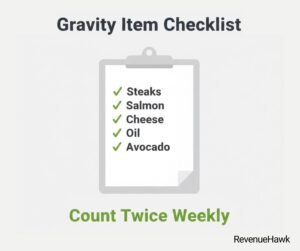
- Pick 10 gravity items (the stuff that moves your food cost: proteins, cheese, fryer oil, top sauce, top starch).
- Track: beginning inventory, purchases, ending inventory, and sales mix for those items every week.
- Compare to what you should have used based on recipe specs.
How to stop losses at the receiving door of my restaurant?
Most restaurants run receiving like this: one person checks boxes, signs, and moves on. That’s how you pay for product you didn’t get, accept substitutions you didn’t price, and start the week behind.
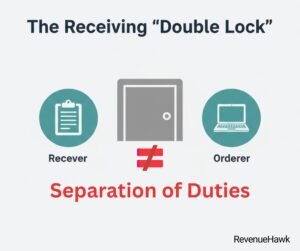
To prevent these from happening, we advise operators to use two controls:
- Separation of duties (receiver can not be the person who places the order).
- Spot checks (random weights/counts on high-cost SKUs).
Want stronger controls? Use the RevenueHawk 15-Point Weekly Food Cost Audit. Not because audits are exciting — because they make the standard clear and remove excuses.
How to make recipes and portions non-negotiable?
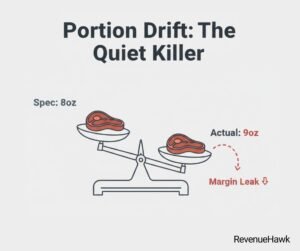
Portion drift is the quiet killer. One extra ounce here, a heavy hand there, and you’re donating margin all day.
There are two tools that can fix this fast:
- Costed recipes (so you can lock in the target cost)
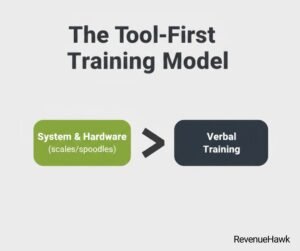
- Portion hardware (scales, spoodles, ladles, slicer settings)
Start with accurate recipe costing. If your recipe costs are wrong, you’ll chase ghosts.
Then implement portion control. The goal is not micromanagement. The goal is consistency.
And don’t forget: training alone doesn’t fix portions. You need the right tools to fix portions. Training just teaches people how to use the tools.
How to reduce supplier-driven shrink (price variance) without begging vendors?
f you’re not negotiating, you’re choosing to overpay.
But the best negotiation isn’t a phone call. It’s the leverage you create by clean specs and clean buying patterns.
Use the supplier negotiation tactics with one twist we see work best: don’t start with “lower my price.” Start with “here’s our spec, here’s our volume, here’s what we’ll commit to if the pricing holds.”
Also, keep your eyes open for tariff and import cost swings — operators had to sub ingredients and rethink sourcing in late 2025, as Restaurant Dive reported.
How to catch sudden spikes before they ruin a month?
Spikes don’t just happen They’re usually a delayed detection problem .
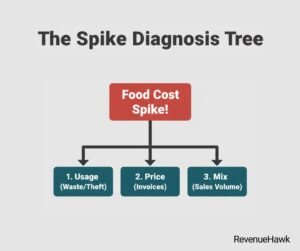
We advise operators to use our spike playbooks built around three questions:
- Did usage change? (portion drift, waste, theft)
- Was the price changed? (vendor, spec swap, invoice error)
- Did mix change? (more low-margin sales than expected)
If you want to make smart moves, track the market. A monthly read like Black Box’s Monthly Restaurant Trends Review keeps you current on the trends that matter.
CASE STUDY: A REAL EXAMPLE FRANCHISE LOCATION (SANDWICH CHAIN)
Restaurant Type
Quick Service (Sandwiches)
Location
Metro suburb (U.S.)
Seats
42
Problem Identified
Food cost randomly high; weekly variance swings; frequent stock-outs on high movers.
What Was Implemented
A tighter receiving log, gravity-item counts 2x/week, calibrated portion tools, and manager accountability on voids/discounts.
Results
Food cost stabilized within 0.6 percentage points week-to-week; waste events dropped; inventory days on hand tightened without stock-outs.
What Happened
The biggest driver wasn’t just doing more counting. It was the five daily inventory habits — simple behaviors like labeling open dates, locking high-cost items, and doing tiny cycle counts instead of one painful monthly count.
KEY MISTAKES: WHAT TO AVOID
1. Cameras don’t fix culture.
Controls do.
2. Monthly inventory is too slow.
By then, the leak is gone and the lesson is useless.
3. Prep more just to be safe creates waste.
Safety stock is not a strategy.
4. If recipes aren’t costed, your pricing is fantasy.
No costing, no control. Price on facts, not vibes.
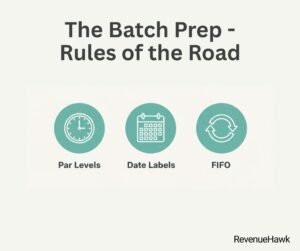
5. Batching without a system is just faster waste.
Batch with rules or don’t batch. Par levels, dates and FIFO — or you’re speeding up spoilage.
If you want waste and labor to drop together, don’t just push harder. Build the batch prep system so prep volume matches real demand, not gut feel.
METRICS: THE NUMBERS THAT MATTER
Keep these on one page. Review weekly.
Actual Food Cost %
Actual Food Cost % = (Beginning Inventory + Purchases − Ending Inventory) / Food Sales
Theoretical Food Cost
Theoretical Food Cost = Sum of (Menu Item Sales × Recipe Cost)
Food Cost Variance ($)
Food Cost Variance ($) = Actual COGS − Theoretical COGS
Waste % (by item)
Waste % (by item) = Waste Qty / Purchased Qty
Portion Drift Cost
Portion Drift Cost = (Actual weight – Spec weight) × Portions Sold × Cost per Weight Unit
Beverage Cost %
Beverage Cost % = Beverage COGS / Beverage Sales
Two important levers can move your profit fast — if you use them correctly:
- The 28% pricing target formula — use it to set guardrails, not to pretend every item should hit the same percentage.
- The beverage margin math — because taking charge of pour sizes and inventory accuracy is one of the fastest ways to boost your margins and turn a good P&L into a great one.
HOW TO MAKE IT LAST
Here’s the checklist we’ve seen keep controls alive past week three:
- One owner/GM profit walk per week: cooler, dry storage, line and bar.
- Gravity-item counts 2x/week.
- Recipe cards printed and posted for top 20 sellers.
- Portion tools visible, not hidden in a drawer.
- Waste log that takes only 30 seconds, not 30 minutes.
- One variance huddle weekly: what moved, why, what are you changing?
This is where recipe engineering for profit becomes practical: you’re not just lowering cost — you’re designing dishes that are harder to mess up and easier to execute.
Curious how tech can help? The Food Institute provides an overview of how AI will impact restaurants in 2026.
THE RESET YOU NEED
Here are a few beliefs we wish every operator would always remember:
- Shrink is a process problem until proven otherwise.
- Complex menus create invisible waste.
- If it’s not measured weekly, it’s not managed.
That’s why we love two moves that may feel painful but print money:
Not because menu engineering is trendy. Because fewer SKUs means fewer chances for spoilage, mis-picks, wrong prep, and walkaways.
ACTION PLAN: WHAT TO DO NEXT
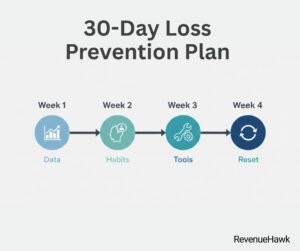
If you’re ready to make a move, do this over the next 30 days: (Week 1) get baseline numbers and pick gravity items, (Week 2) tighten receiving and inventory habits, (Week 3) lock recipes and portion tools, and (Week 4) reset the menu/pricing and train the team on the new rules of the game.
How to get baseline numbers and prep my data?
Pull 8 weeks of invoices and sales. Pick the 10 gravity items. Start the weekly variance sheet. If you can’t explain variance in one sentence, you don’t have controls yet.
How to tighten receiving and inventory habits?
Add receiving logs, random spot checks, and storage rules (locks for high-cost items; limited access). Also — track big-ticket equipment and assets so losses and insurance claims don’t become chaos later.
How to standardize the line (lock recipes and portion tools)?
Cost the top recipes. Print recipe cards. Add portion tools. Run one portion line check per shift for 7 days. You’ll be shocked how fast drift disappears when it’s visible.
How to reset pricing and protect traffic?
This is where we see most owners panic. Don’t. If costs go up, you either raise prices, reduce costs, or accept less profit.
Use price increases smartly with a simple rule: raise on items with strong demand and low price sensitivity, and protect your value anchors that guests use to judge your whole menu.
Don’t want to guess what’s coming? Use signals instead. The National Restaurant Association’s What’s Hot Culinary Forecast reports what industry operators say will be hot in 2026.
FREQUENTLY ASKED QUESTIONS (FAQ)
1) What’s a normal shrink number?
It depends on concept and controls, but if your actual vs theoretical variance is consistently more than 1–2 points, you have leaks worth hunting weekly.
2) How do I know if it’s theft or waste?
Waste leaves patterns (prep volume, spoilage, station habits). Theft leaves gaps (missing high-value items, weird voids/discounts, bar variance). The point is: measure variance first, then investigate.
3) Do I need software to fix this?
No. You need rhythm. A spreadsheet and weekly counts on the right items beats fancy tools used once a month.
4) Won’t tighter controls hurt morale?
Not if you frame it right: You are protecting everyone’s jobs and raises. Most strong employees like clear rules — because it stops the chaos.
FINAL THOUGHTS
Loss prevention isn’t a one-time fix. It’s a profit habit.
Here’s the RevenueHawk truth: most restaurants don’t fail because they don’t get enough customers. They fail because they’re leaky. Tighten the system, and suddenly you don’t need miracles — just consistency.
And the plays in this article are just a small part of our Restaurant Growth Engine system: diagnose the real constraint, fix it in the right order, and make the new standard stick.