

Do you often think your supplier raising prices is natural — and something out of your control? It’s not. It’s a system. And once you see the system and learn how to negotiate with restaurant suppliers, you stop losing money in slow motion .
At RevenueHawk, we’ve seen the same pattern across thousands of restaurants: the operators who get the best pricing don’t have better relationships. They have better proof. Better comparisons. Better control. They show up like a buyer, not a beggar.
That’s why you should never think of negotiation as a standalone trick. It only works when it’s connected to your usage, recipes, inventory, and menu strategy — otherwise you’ll occasionally win a discount and still watch food cost climb.
Want the fundamentals of cost control? Start with our food-cost optimization guide. And then come back here, because this article is the part where you take that reality and force it into better vendor terms.

KEY POINTS: WHAT YOU’LL LEARN
- Step-by-step how to negotiate with restaurant suppliers: 7 steps we use to turn vendor conversations into lower invoice totals.
- Why this matters: The industry math that makes “just raise prices” a lazy (and risky) answer.
- Case study: How a major brand protects margins with contracts, options, and leverage.
- Mistakes: Five blunt truths that explain why most negotiations fail before they start.
- The numbers that matter: The formulas that keep you from negotiating blind.
- Make it last: How to stop “deal decay” (when your good pricing quietly disappears).
- The reset you need: The mindset shift that makes suppliers take you seriously.
- What to do next: A 30-day execution plan to lock in savings and keep them.
WHY THIS MATTERS
Here’s what we tell operators: suppliers don’t decide your price. Your operation does.
When your ordering is sloppy, your specs are vague, your invoices aren’t checked, and your menu isn’t engineered, you broadcast one thing: “We won’t notice.” That’s when fees creep in, pack sizes change, and “temporary” surcharges become permanent.
And the macro pressure is real, too. The National Restaurant Association reported total restaurant input costs surged about 30% since before the pandemic and highlighted large increases in both food and labor costs since 2019.
Consumers see it too: the the U.S. Bureau of Labor Statistics reported food prices rose 3.1% from December 2024 to December 2025, with food away from home up 4.1%. And the USDA’s latest outlook forecasts food away from home rising ~4.6% in 2026 (midpoint forecast).
So yes — costs push up. But here’s what most operators miss:
- You can’t negotiate your way out of chaos.
- You can’t “relationship” your way out of bad data.
- And you can’t price your menu correctly if your costs are floating.
If you’re still wondering why your food cost won’t behave, it’s usually not one big thing — it’s usually a bunch of hidden leaks and profit killers adding up.
STEP-BY-STEP: HOW TO NEGOTIATE WITH RESTAURANT SUPPLIERS
To negotiate better supplier pricing, we use a 7-step procurement audit: (Step 1) prove your numbers, (Step 2) tighten your specs, (Step 3) compare true unit costs, (Step 4) trade the right concessions, (Step 5) create real alternatives, (Step 6) lock smart contract terms, and (Step 7) install a system that prevents backsliding.
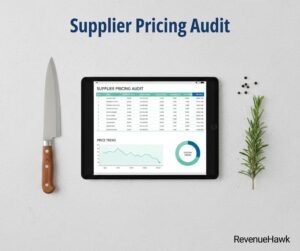
How do I “prove my numbers” before I ask for anything?
Your supplier hears discount requests all day, but the only ones they respect come with receipts.
You start with a simple buyer pack:
- last 13 weeks of purchases
- top 30 SKUs by spend
- your effective price per usable unit (not per case).
If you can’t produce that in 15 minutes, you’re not negotiating — you’re guessing.
This is where our 15-point weekly cost audit becomes leverage. Because the operator who audits weekly can say, “Here’s the trend, here’s the exact SKU drift, here’s where the increase is coming from.” That’s very hard to ignore.
How do I tighten specs so vendors can’t play games?
“Chicken breast” is not exactly a spec. It’s basically an invitation to get whatever is convenient for them.
Be very specific. Lock in: brand, pack size, trim, weight range, grade, and acceptable substitutions in writing. When you don’t, your price comparisons are fake, because you’re not buying the same product.
Want the fastest way to stop spec drift? Tie specs to recipes and yields. The moment you do that, your supplier can’t hide behind “equivalents.”
How do I compare apples to apples on pricing?
Here’s what we’ve learned: negotiating on case price is a waste of time.
The only number that matters is cost per usable unit:
- Usable ounces (or portions) after trim/yield
- Plus freight/fuel/fees
- Minus rebates/credits
- Adjusted for pack size changes
This is exactly why we push operators to build costs from the recipe up. If you don’t have that baseline, you can’t tell if a “better” deal is actually worse. That’s the whole point of accurate recipe costing.
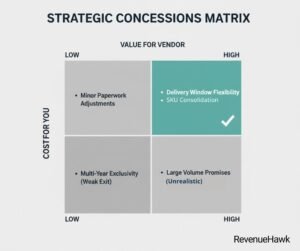
How do I trade concessions without giving away the farm?
Suppliers love when restaurants give concessions that cost the restaurant money later.
The concessions that work:
- Volume commitment on a short leash (e.g., 90 days)
- Delivery window flexibility (if it truly doesn’t hurt service)
- Consolidating SKUs (fewer oddball items = better pricing)
The concessions that usually backfire:
- Multi-year exclusivity with weak exit clauses
- “We’ll grow into it” volume promises
- Accepting vague market pricing language with no guardrails
Your goal is very simple: give them something cheap for you, valuable for them.
How do I create alternatives if I’m not a big chain?
Most independents negotiate like they have no options. Then they wonder why they get treated like they have no options.
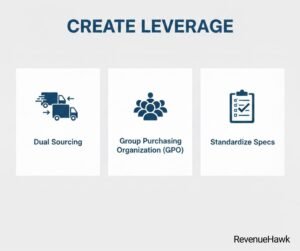
Here are three ways you can create leverage:
- Dual-source your top 10 SKUs (even if you only buy 10% from supplier #2).
- Use a group purchasing organization (GPO) to borrow scale.
- Standardize specs so multiple vendors can quote the same item.
NRN explains group purchasing in case you’ve never used it before.
How do I negotiate contract terms that protect me from spikes?
Price is only one lever. Terms are the other.
What you want is:
- price review cadence (monthly/quarterly)
- caps on increases
- transparency on surcharges
- substitution rules
- service levels (fill rate, delivery cutoffs)
- credits for shorts and quality issues
And you want your contract to acknowledge reality: wholesale prices move. The smart move is tying parts of your basket to a market index with limits.
A clean public benchmark you can point to is the Producer Price Index trend for processed foods (so you’re not arguing vibes).
How do I stop the “good deal” from going away without noticing?
This is the part everyone skips — then they pay for it for the next 12 months.
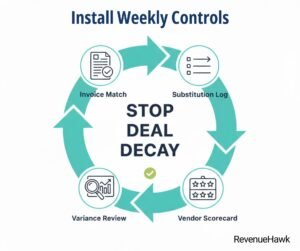
Here’s what to do. Install a weekly control loop:
- invoice match (contract price vs billed price)
- substitution log (what changed, who approved it)
- “top 10 variance” list (what moved and why)
- vendor scorecard (fill rate, credits, late deliveries)
RevenueHawk Insight (from our platform data)
We reviewed invoices across a large set of full-service and fast-casual restaurants. Two problems kept showing up—and they change negotiations fast:
- Pack-size swaps hidden under the same SKU name, which changes your yield.
- Invoice prices that sometimes don’t match the contracted rate.
When operators fixed those two leaks before negotiating, the median improvement was 1.4 food-cost points within 60 days — without switching distributors.
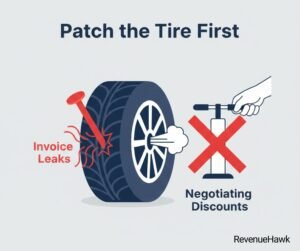
That’s why we say this: asking for a discount before you fix invoice leaks is like patching a tire while the nail is still in it.
CASE STUDY: MEXICAN GRILL CHAIN
Restaurant Type
Fast casual
Location
Nationwide (U.S.)
Seats
60–80 per unit (varies)
Problem Identified
Inflation and tariff uncertainty creating cost exposure on specific ingredients and equipment. Restaurant Dive provides a breakdown of how major chains described tariff and supply chain exposure.
What Was Implemented
- strong domestic sourcing bias
- supplier mitigation work
- inventory planning
- multi-year pricing strategies where possible
Results
Reduced exposure on large parts of the basket; clearer forecasting of margin impact; fewer “surprise” spikes on planned volumes
The chain has described how tariff dynamics can create targeted exposures (like certain imports) while overall impact can be contained through sourcing strategy and supplier work.
What matters for you isn’t that you’re a big chain. It’s the structure:
- they don’t rely on hope
- they create options
- they lock terms
- they plan inventory
- they communicate expectations to suppliers early
If you’re fighting unpredictable week-to-week swings, you should focus on spike-proofing your food cost — because suppliers can’t “fix” volatility you haven’t measured.
KEY MISTAKES: WHAT TO AVOID
1.Negotiating with feelings instead of facts.
If your pitch is “prices are killing me,” you already lost. Bring itemized variance, specs, and competitive quotes.
2. Letting substitutions happen without a rule.
Every substitution is a hidden price change. Approve it like you approve overtime.
3. Chasing the cheapest case price while ignoring yield.
The cheaper protein that trims worse is usually more expensive on plate.
4. Trying to negotiate before portion control is stable.
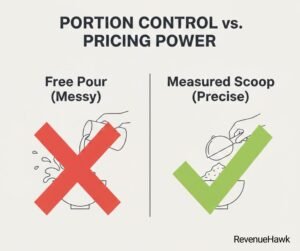
If cooks free-pour and free-scoop, your cost moves every night. Don’t skip portion-control systems and then wonder why better pricing didn’t stick.
5. Accepting market pricing without guardrails.
Markets move. That’s real. What’s not real is giving up all control with zero caps, zero cadence, zero transparency.
METRICS: THE NUMBERS THAT MATTER
Keep this simple. Use a few numbers that drive decisions:
Food Cost %
Food Cost % = COGS / Food Sales
Prime Cost %
Prime Cost % = (COGS + Labor) / Sales
Price Variance (per SKU)
Price Variance (per SKU) = (Actual Price − Contract Price) × Quantity Purchased
Yield-Adjusted Unit Cost
Yield-Adjusted Unit Cost = (Case Price / Usable Yield Units)
Inflation Pass-Through Rate
Inflation Pass-Through Rate = (Menu Price Change %) / (Basket Cost Change %)
Two specific targets that keep you sane:
- Build pricing using a food-cost pricing formula so supplier changes don’t wreck your margin silently.
- Don’t ignore drinks. Use a beverage cost % calculator because beverage margin often pays for food volatility when managed right.
HOW TO MAKE IT LAST
Negotiation wins are fragile and can go away fast. So you need a system that keeps saving money even when no one is paying attention.
Weekly (non-negotiable)
- invoice match (top 30 SKUs)
- credits log (shorts, quality, late deliveries)
- substitution approvals
- variance review (what moved, what’s the cause)
Daily (kitchen habits that protect purchasing)
- receiving checklist (count, temp, quality, substitutions)
- par levels for core SKUs
- storage discipline (rotation and labeling)
This is where the RevenueHawk loss-prevention playbook helps a lot, because the supplier isn’t your only leak.
And if you want an underrated lever that makes vendor pricing easier to win: reduce complexity in prep. A cleaner prep system tightens forecasting and ordering, which makes you a better buyer. That’s the hidden payoff of batch-prep system that cuts waste.
The Food Institute’s look at 2026 challenges is a useful sanity check for why you should try to lock terms early.
THE RESET YOU NEED
- You’re not “asking for a discount.” You’re buying.
- Your supplier isn’t the enemy. Your lack of control is.
- A cheaper invoice that increases waste is not savings. It’s a trap.
- Every menu item is a purchasing decision.
If you want one ruthless move that makes negotiations easier fast: stop funding bad menu items and kill low-margin menu losers, and watch your leverage improve (because your basket gets tighter and your volume concentrates).
ACTION PLAN: WHAT TO DO NEXT
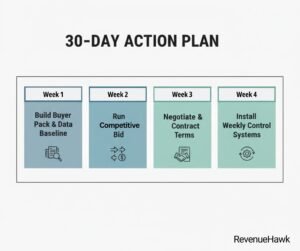
If you want this done in the next 30 days, do it as follows: (Week 1) build your buyer pack and baseline costs, (Week 2) run a competitive bid on your top SKUs, (Week 3) negotiate terms and lock contract language, and (Week 4) install the weekly controls that prevent price creep.
How do I prepare my data?
Pull 13 weeks of invoices, rank SKUs by spend, and calculate yield-adjusted unit cost for the top 30. Then set par levels and confirm you can track weekly COGS consistently using your weekly food-cost tracking method.
How do I run the bid?
Send a one-page spec sheet to at least two vendors (and/or a GPO). Require apples-to-apples: same brand, same pack, same trim, same delivery requirements. If they can’t quote it cleanly, that vendor is telling you who they are.
How do I negotiate and lock it?
Negotiate the total delivered cost, then terms:
- price cadence
- caps
- surcharge transparency
- substitution rules
- service levels
Then get it signed. If it’s not written, it’s not real.
How do I install the controls and make it sustainable?
Install weekly invoice match and variance review. Create a vendor scorecard. And audit inventory behavior — because if your counts are fantasy, your purchasing will be too.
This is where menu engineering basics helps, because a tighter menu creates a tighter purchasing basket.
And if you still need margin after you negotiate, don’t panic-discount or slash portions. Use controlled price moves with price-raise psychology tips.
Black Box Intelligence’s trend snapshot shows sales and traffic moving in different directions — exactly why margin control matters more than ever.
FREQUENTLY ASKED QUESTIONS (FAQ)
Q1: Should I threaten to switch suppliers to get a better deal?
No. Threats make you look unstable. Build a real alternative and let the numbers do the threatening.
Q2: What should I negotiate besides price?
Terms that stop leakage: rebates, credits, fees, substitutions, delivery standards, and price review cadence.
Q3: How many vendors should I quote?
At least two for your top 10–30 SKUs. More isn’t better if your specs aren’t tight.
Q4: What if my menu is the real problem, not my vendor?
Then negotiation won’t save you. You need margin-designed dishes. That’s what recipe engineering for higher margin is for.
FINAL THOUGHTS
Here’s the bottom line: If you only take one thing from this, stop asking suppliers to “help you out.” Start showing them you run a tight machine. Tight machines get tight pricing.
Remember, negotiation is not charisma. It’s math, options and enforcement.
And remember: these plays are just a small part of our RevenueHawk Restaurant Growth Engine system — the full system ties purchasing, menu design, labor, ops execution, and pricing into one loop so you don’t win a negotiation and lose the war.