
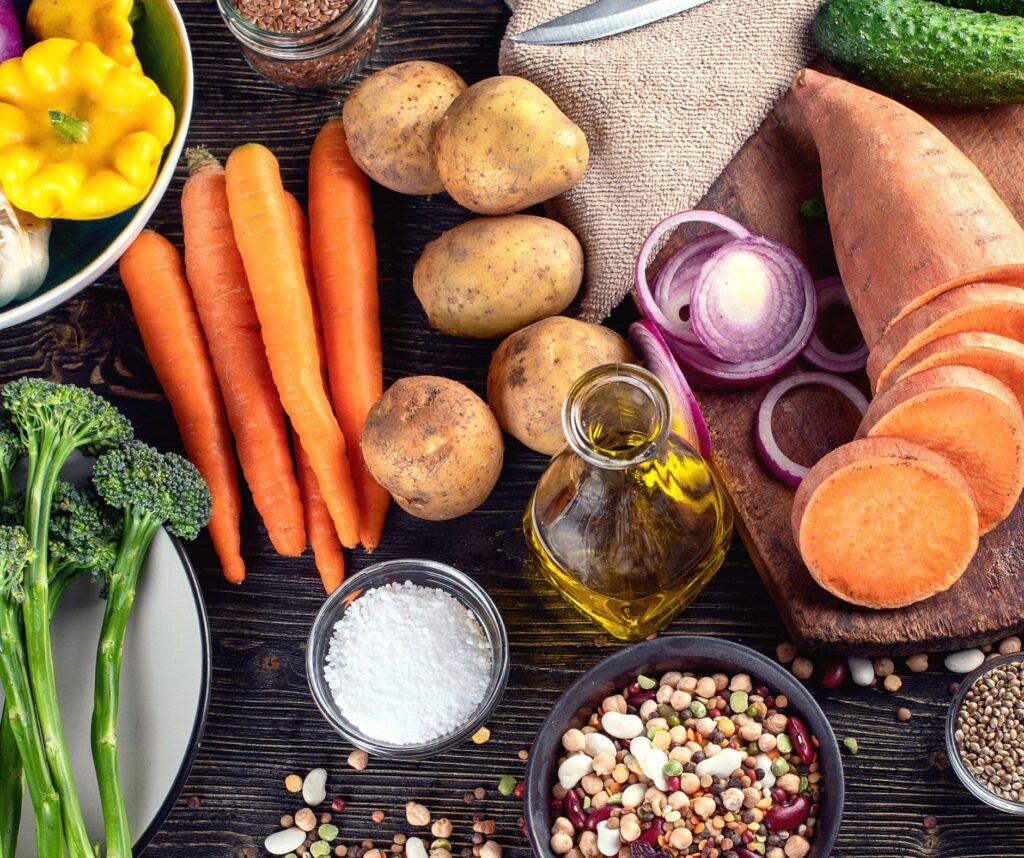
What if your best-seller is secretly your biggest leak? The cure is restaurant recipe engineering: tighter recipes, tighter costs, bigger margins.
We see this all the time: operators chase quality by adding “one more garnish,” or chase profit by shaving ingredients — then wonder why guests stop coming back. The truth is simpler: restaurants don’t lose money on one single thing. They lose it on many things through a chain reaction — portion drift leads to messy prep, which creates extra waste, which forces cooks to rush, resulting in inconsistent plates and refunds.
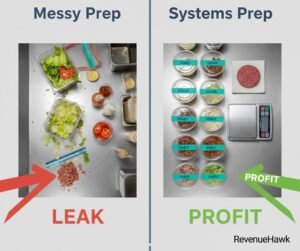
At RevenueHawk, we’ve watched recipe engineering fix all of that — when it’s done like a system, not just a spreadsheet. The fastest path is to start with the key fundamentals: cost truth, portion control, prep design, and menu mix. That’s why we anchor the work inside our how to lower food cost guide — because recipe engineering isn’t a chef project. It’s an operating model.
And yes, there is no question about the fact that pricing pressure is real. “Food away from home” inflation stayed elevated through 2025 — according to the U.S. Bureau of Labor Statistics (BLS) CPI review — which means your costs and your guest’s price sensitivity are colliding at the same time.
The part that we see most teams miss is that recipe engineering isn’t about making food “cheaper.” It’s about making profit repeatable and predictable — while the plate stays great. That includes classic menu engineering basics — but we’re going one layer deeper: designing dishes that behave well in a real kitchen.

KEY POINTS: WHAT YOU’LL LEARN
- Step-by-step restaurant recipe engineering: a simple, repeatable method to redesign dishes for margin and consistency.
- Why this matters: what’s changing in 2025–2026 and why “just raise prices” is a trap.
- Case Study: a known brand-style playbook you can copy, with numbers that matter.
- Key mistakes we see: five blunt truths that explain why most recipe costing projects die.
- The numbers that matter: the few formulas that actually drive profit decisions.
- How to make it last: how to keep your recipes profitable after the first cleanup week.
- The change you need to make: the mindset shift that stops you from optimizing the wrong things.
- Action plan: a 30-day plan that turns this into action, not homework.
WHY THIS MATTERS
We’ve analyzed thousands of restaurants, including the biggest brands. Here’s what we found: they don’t win because their recipes are better. They win because their systems are better.
Everyone in the industry is saying the same thing: costs are still high, and restaurant owners are getting crushed from both sides. Food and labor are up, but guests still want low prices. Even after the drop in December, wholesale food prices are still way above pre-pandemic levels. The NRA reported that in December 2025, the Producer Price Index for all foods was 34% higher than February 2020.
USDA is projecting food-away-from-home prices will climb another 4.6% in 2026. That means more price swings — and more uncertainty — for operators.
So why do traditional solutions fail?
Because most operators do one of these:
- cut ingredients and hurt quality,
- raise prices randomly and lose trust,
- yell at the kitchen about portions (then it drifts again next week).
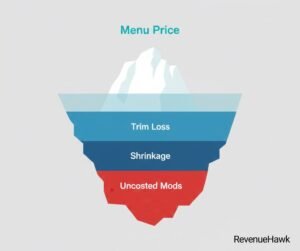
If you’re asking, why food costs keep running hot even after fixing it? — well you’re not crazy. Yet, the common culprits are predictable: unmanaged yield loss, portion creep, uncosted mods, inconsistent prep, and weak inventory cadence. That bundle shows up so often we literally label it hidden food-cost killers.
And again: 2026 is not shaping up to be calm. Restaurant Dive’s 2026 outlook points to cost pressure and supply chain disruption risks that make smart recipe design even more valuable.
And though consumers are expecting more menu price inflation as reported by Restaurant Business, the move now is not charge more. The move is: engineer dishes that print profit even when costs wobble— and then price them with intent using a 28% food-cost pricing formula.
STEP-BY-STEP: HOW TO DESIGN HIGH-PROFIT DISHES
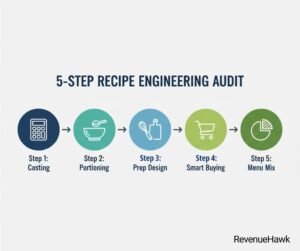
To design high-profit dishes without sacrificing quality, we use a 5-step recipe engineering audit: (Step 1) cost the recipe like an accountant, (Step 2) lock portions like a factory, (Step 3) redesign prep like a systems engineer, (Step 4) buy smarter without changing the dish, and (Step 5) manage menu mix like a portfolio.
How do you cost a recipe so the numbers are real (not vibes)?
Start with accurate recipe costing. Here’s one rule we have: if you don’t cost by usable yield, you’re lying to yourself.
What you should do in practice:
- Cost every ingredient by edible portion (trim, cook loss, peel loss).
- Cost every small thing (oil, salt, sauces, herbs, to-go packaging) because those add up fast.
- Cost the most common modifiers (extra protein, swap sides, add-ons) as if they’re separate mini-recipes.
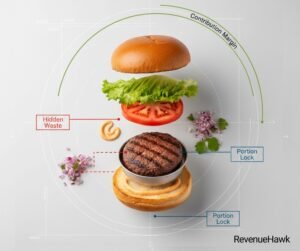
RevenueHawk Insight (from our platform data): 61% of the thousands of recipes we reviewed were under-costed because small inputs weren’t counted (oil, finishing butter, garnish, ramekins). The average miss was $0.14–$0.27 per plate — which doesn’t sound scary until you multiply it by 400 covers a day.
How do you stop portion drift without turning the kitchen into a fight?
We’ve seen lots of restaurants where recipes look perfect on paper but still fail on the line. Why? Because when people get slammed, they portion with their eyes.
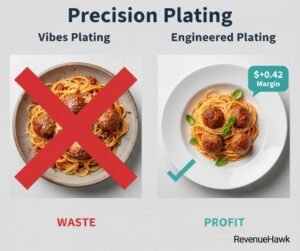
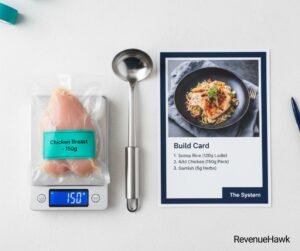
That’s why you eliminate over-portioning with tools that make the correct portion the easiest portion.
- pre-portioned proteins (batch weighed into deli cups or vacuum packs),
- ladles and scoops that match the recipe,
- build cards that show the plate in 5 seconds,
- and one plating standard photo per dish (not a 12-page manual).
If portion control is a memory test, you already lost. Friday night will break it every time.
How do you redesign the recipe so it’s fast, consistent, and still tastes premium?
Most margin work fails because it attacks the guest-facing ingredients first. We usually advise operators to do the opposite: fix the process before you touch the flavor.
Labor is still a margin squeezer across the industry, and it’s not going away. The NRA has highlighted that labor cost pressure remains above historical norms.
This is where batch-prep systems become your secret weapon:
- Turn one-off prep into a mother sauce that feeds 3 dishes.
- Use one roast method that creates two menu components (protein and stock).
- Build a prep map that reduces open containers and half-used produce.
How do you lower unit costs without downgrading the dish?
A lot of operators talk to suppliers the wrong way. They ask for discounts across the board, and it doesn’t work. It’s too vague, and it gives the supplier no reason to say yes.
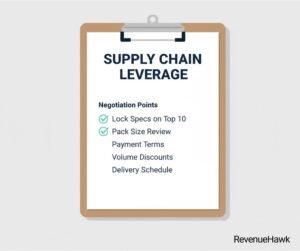
Use our supplier negotiation playbook and focus on leverage points:
- lock specs on your top 10 spend items (so bids are apples-to-apples),
- consolidate where it matters (not everywhere),
- negotiate on pack size, trim level, and delivery cadence,
- and set price review triggers when markets move.
With tariffs and logistics uncertainty, negotiation becomes even more important. See how restaurants have been navigating tariff-related pressures recently, as discussed in a Restaurant Dive article.
How do you manage food cost weekly without buying a fancy tech stack?
You don’t need expensive software to run tight numbers — you just need rhythm.
Learn how to track weekly food costs with these three habits:
- same-day counts for the same categories every week,
- one person owns invoices and credits,
- you track what changed (the delta)instead of staring at the total.
FRED keeps the CPI series updated and easy to chart, if you want a clean, public benchmark for the direction of “food away from home” inflation.
CASE STUDY: SHAKE SHACK-STYLE BURGER AND SHAKE MENU
Restaurant Type
Better-burger fast casual (Shake Shack-style)
Location
Chicago, IL
Seats
96
Problem Identified
Two top sellers were high volume but low margin due to portion drift (fries and sauce) and hidden waste (fresh produce and dairy). Ticket times spiked during rush, causing comped meals and remake waste.
What Was Implemented
- Rebuilt two hero items with tighter yields and fewer “open containers” on the line.
- Standardized fries portion with a fixed scoop and timed hold policy.
- Converted two prep steps into batch components used across four menu items.
- Repriced one item with a value anchor next to it (not a random price hike).
Results
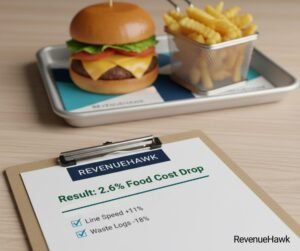
- Food cost on the two hero items dropped 2.6 percentage points without changing the guest-facing ingredients.
- Line speed improved 11% during peak (measured by tickets under 8 minutes).
- Weekly waste logs showed 18% fewer remakes/voids tied to build errors within 30 days.
KEY MISTAKES: WHAT TO AVOID
Here are the pricing moves that we almost always see blow up:
1.Expecting a spreadsheet to save you from sloppy prep.
If the prep is messy — unclear goals, inconsistent definitions, incomplete data, no validation rules — the spreadsheet just becomes a polished container for chaos.
2. Not standardizing plate cost.
If plate cost isn’t locked in, your target margin is just wishful thinking.
3. Not having loss-prevention controls in place.
Waste is not a kitchen mistake — it’s a control problem. That’s why loss-prevention controls belong in recipe engineering, not later.
4. Swapping ingredients to save pennies while your top sellers are underpriced is self-sabotage.
If your top sellers are underpriced, you’re bleeding dollars on every single order — volume just makes the loss bigger.
5. Keeping low-margin items because a few regulars like it is emotional accounting.
Every low-margin item quietly taxes your operation: it takes up prep time, inventory space, line attention, and menu real estate that could go to something that actually funds payroll and growth.
METRICS: THE NUMBERS THAT MATTER
Keep this simple. Use a few numbers that drive decisions:
Plate Cost ($)
Plate Cost ($) = sum of ingredient edible-portion cost + disposables + garnish/condiments
Food Cost % (item)
Food Cost % (item) = Plate Cost / Menu Price
Contribution Margin
Contribution Margin = Menu Price − Plate Cost
Prime Cost %
Prime Cost % = (COGS + Labor) / Sales
Menu Mix %
Menu Mix % = Item Sales / Total Sales
And don’t ignore drinks. Beverage is where many restaurants quietly save the whole P&L. Build and monitor beverage cost percentage the same way you do food — by recipe, not by guess.
HOW TO MAKE RECIPE ENGINEERING LAST
If you want recipe engineering to last, you need maintenance, not only motivation.
Here’s the checklist we tell operators to put in place:
- One source of truth recipe card per item (with edible yields).
- One plating photo that matches the costed portion.
- A weekly variance review (top 10 items only).
- A waste log that’s actually used (remakes, overcooks, spoilage).
- Tight receiving rules (count, temp, spec checks).
- Build daily inventory habits so shrink doesn’t hide until month-end.
THE RESET YOU NEED
Most operators try to save money by trimming around the edges.
The fundamental reset is this: your menu is a portfolio of winners and losers. Some items fund the business, some items drain it.
And yes — sometimes you have to kill the losers. Not because you don’t like creativity — but because profit pays the bills. And staying open is the goal.
Also, stop treating recipe engineering like a one-time event. Costs move. Labor moves. Guests move. Your menu has to move with them.
ACTION PLAN: WHAT TO DO NEXT
To get this done in 30 days without chaos, run the work over the next 30 days as follows: (Week 1) build your costing truth, (Week 2) standardize portions and prep, (Week 3) reprice and rebalance the menu, and (Week 4) lock controls so it stays fixed.
How do I build cost truth fast?
Start with your top 20 sellers. Cost those first. Don’t overcomplicate it — don’t try to boil the ocean.
If you discover a surprise jump (it happens), don’t panic — run a food-cost spike reset by checking: invoices, yield loss, portion drift, and comps/remakes.
How do I standardize portions and prep without slowing the team down?
Here’s how to fix the build flow:
- pre-portion where it removes decisions,
- reduce steps that require precision during rush,
- eliminate open container chaos on the line.
How do I reprice menu and raise profit without scaring customers?
Don’t think raising prices. Think reframing value.
Use pricing psychology tactics like:
- anchors (one premium item makes the core item feel fair),
- bundles that protect margin,
- and smart menu placement.
How do I lock controls so they stay fixed and don’t slip back?
Install weekly rhythm:
- invoice review,
- top-item variance,
- waste log review,
- and retrain only the builds that drifted.
FREQUENTLY ASKED QUESTIONS (FAQ)
Q1: Can I do recipe engineering without changing my ingredients?
Yes. Most margin wins come from yield, portion control, and prep design first.
Q2: What’s the fastest tell that a dish is a profit problem?
High sales and low contribution margin, and lots of mods/remakes. That combo is loud.
Q3: Should I remove low-margin items even if they’re popular?
Not always. Sometimes you fix the process, reprice, or redesign. But if it still drains cash, it’s not a fan favorite — It’s a tax you’re choosing to pay.
Q4: How often should recipes be re-costed?
Re-cost your top sellers at least every two months, and re-cost immediately when vendor pricing moves.
FINAL THOUGHTS
The key point to take home from this article is that most restaurants don’t have a food cost problem. They have a systems problem that shows up as food cost.
Recipe engineering is one of the highest-ROI moves because it hits everything at once: speed, waste, consistency, pricing confidence, and guest trust.
But the plays here are just a small part of our Restaurant Growth Engine system. The winners don’t do random fixes. They build a machine where great food and great profit happen at the same time.