

How do you fix sudden restaurant food cost spikes and build long-term stability for your restaurant?
How does your food cost jump 5 percentage points in a week… when your sales barely moved?
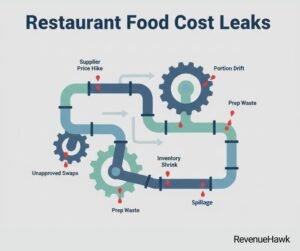
We’ve seen this play out so many times. Among the restaurants we analyzed that had a sudden spike, most weren’t dealing with a single problem. They had three small leaks that showed up at the same time: a quiet supplier increase, portion drift on the busiest station, and inventory that looked fine — until you counted it.
Here’s what you need to know: a food cost spike is rarely bad luck. It’s usually a system that’s been running on vibes. If you want the full framework we use to diagnose this fast, start with our food-cost optimization guide.
RevenueHawk Insight: Our experience analyzing thousands of restaurants shows that 40%+ of food cost spikes start at the invoice level—price changes, incorrect pack sizes, or items swapped without approval—long before waste or theft becomes the bigger issue.
Most operators don’t catch it for almost three weeks. Not because they don’t care, but because they aren’t watching the right numbers each week.

KEY POINTS: WHAT YOU’LL LEARN
- Step-by-step: The exact sequence we use to stop the bleed in days, not months.
- Why This Matters: Why building long-term stability is so important.
- Case Study: A known brand-style playbook you can copy.
- What to avoid: Five key mistakes that explain why most fixes fail.
- Metrics: The few formulas that keep you honest.
- Make It last: The operating rhythm that helps you prevent spike whiplash.
- The reset you need: The belief shift that makes this sustainable.
- Action Plan: A 30-day plan that your team can actually execute.
WHY THIS MATTERS
If you’re feeling squeezed, it’s not in your head.
- Growth vs. Profit: National Restaurant Association projections point to continued sales growth in 2026—but top-line revenue doesn’t equal bottom-line profit when input costs move faster than your menu can keep up.
- The Pricing Lag: Recent BLS Consumer Price Index data shows that food away from home (menu prices) continues to climb year-over-year. This isn’t a sign of “greed”; it’s a lagging indicator of operators desperately trying to chase wholesale volatility.
- The Pressure Cooker: Summaries from Restaurant Dive capture how food costs were the top challenge for restaurants throughout 2025, with operators still reporting broad, systemic pressure on their margins.
Big brands already treat food cost like a controlled system: They use tight specs, rigid portions, and aggressive inventory cadences. They don’t hope for stability — they build it.
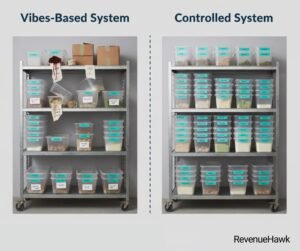
What most operators miss is the real question they should ask: What most operators miss is the real question they should ask. It’s not just, “Why did suppliers charge more?” It’s, “Where did the money leak out of my system?” You need to know the hidden profit-killers, because a food cost spike is rarely the work of a single villain like beef prices; it’s usually a cluster of small, invisible leaks.
STEP-BY-STEP: HOW TO FIX SUDDEN RESTAURANT FOOD COST SPIKES
To turn a sudden spike into long-term stability, we use a 4-step audit: (Step 1) lock the weekly number, (Step 2) verify what your recipes actually cost today, (Step 3) stop portion drift at the plate level, and (Step 4) renegotiate and redesign — so the fix sticks.
How to lock the weekly number fast?
What you need is a weekly rhythm that works even if you don’t have fancy tools. Most restaurants wait for month-end. That’s like trying to steer after you’ve already passed the turn.
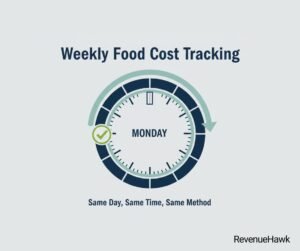
You should start using weekly food-cost tracking and commit to one rule: same day, same time, same method. If Monday AM is inventory, then it’s always Monday AM inventory. Don’t move it because you’re busy. That’s the point.
Here are two practical moves that stop fake spikes:
- Invoice cut-off discipline: count only invoices posted in the same window as the inventory.
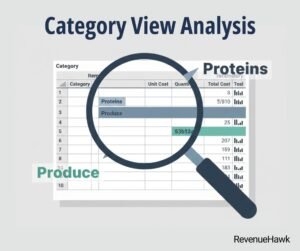
- Category view: track proteins, produce, dry, dairy separately — spikes hide in categories.
Macro Context: To see how grocery vs. restaurant pricing gaps are influencing your guests’ behavior, check the FRED CPI Food-at-Home series.
How to know if it’s a pricing spike or a recipe problem?
Here’s what we see constantly: the operator blames the vendor, but the recipe cost card is six months old, yields aren’t updated, and the prep cook is free-handing trim.
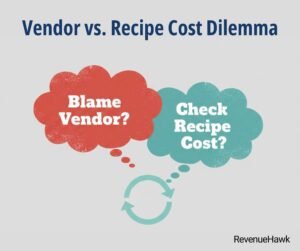
You fix that with accurate recipe costing. You don’t need to make it complicated:
- Update your top 20 items first (the stuff that drives most of your COGS).
- Re-check yields on proteins and produce (trim and cook loss).
- Match pack sizes to invoices (this is where invoice variance quietly wrecks you).
This matters even more because customers are still sensitive to price increases, and many operators are still planning price hikes, as reported by Restaurant Business.
How to stop portion drift without turning your kitchen into prison?
Portion drift is a silent killer. It starts as just a little extra because the guest is nice, and it ends as “why are we down $7,000 this month?”
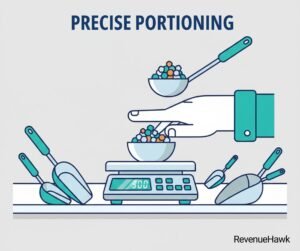
The best operators don’t “remind” people to portion right — they build it into the work:
- Portion happens in prep: pre-portion proteins, sauces, and expensive toppings.
- Tools are non-negotiable: scoops, ladles, spoodles, and scales at the point of use.
- Run a 10-minute check before every shift to confirm the line is set and portions are correct.
When to negotiate suppliers vs. change the menu?
Don’t negotiate blind. If you don’t know your unit-cost drivers and your menu margin reality, you’re just asking vendors for favors.
First, apply tactics from our supplier negotiation playbook on the categories actually moving your COGS (often proteins, oils, dairy). Then do the move most operators avoid: cut the losers. However, if an item is popular but low margin, you don’t automatically delete it — you rebuild it (portion, garnish, prep method, price, or bundling).
Also keep an eye on what’s pressuring operators right now — FastCasual writeup summarizes how tariffs and wage pressure are still showing up in operator surveys and pricing decisions.
CASE STUDY: A REAL EXAMPLE (MEXICAN GRILL)
Restaurant Type
Fast Casual
Location
U.S. metro market (high lunch volume)
Seats
50–80
Problem Identified
Food cost jumped 4.2 percentage points in 3 weeks; and the category data didn’t back the vendor problem story.
What Was Implemented
- Tightened prep with batch-prep systems (pre-portioned proteins and sauces during controlled windows).
- Re-costed top bowls and add-ons, then removed one high-waste SKU and replaced it with a multi-use ingredient.
- Put a daily portion proof on the line (2 items tested per shift).
Results
- Portion variance dropped, waste logs became real, and food cost stabilized within 30 days.
- The bigger win: the unit stopped getting surprised by costs because the weekly signals were finally clean.
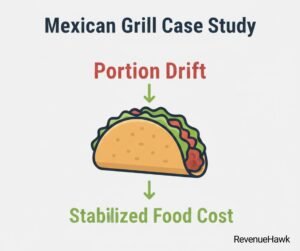
This FSR piece is a real-world reminder that portion-size drift alone can crush your margins.
KEY MISTAKES:
1. You don’t have a food-cost problem. You have a truth problem.
If your inventory timing and invoices don’t match, your spike might be fake.
2. Monthly reviews feel safe, but they’re too late.
They make you feel responsible while the money keeps leaking weekly.
3. If waste and theft aren’t under control, better pricing won’t save you.
Build shrink and loss prevention into the operation —cameras and locks are not the system; behaviors and checks are.
4. Training is not a fix for bad design.
If the line makes portioning hard, your team will drift.
5. Price increases can help short-term, but they don’t solve the real problem.
If the operation is leaking, you’re just charging more to cover the leak.
QSRweb offers a broad industry read on where operators are focusing — especially around food and labor cost controls.
METRICS: THE NUMBERS THAT MATTER
Tracking everything is the fastest way to learn nothing. Pick a few. Track these:
Food Cost %
Food Cost % = COGS / Food Sales
Theoretical Food Cost %
Theoretical Food Cost = (Recipe Cost per Item × Items Sold) / Food Sales
Variance %
Variance % = (Actual COGS − Ideal COGS) / Sales
Prime Cost % (context)
Prime Cost % = (COGS + Labor) / Sales
Waste %
Waste % = Waste $ / Food Purchases $
Now the money makers:
- Aim for the 28% menu pricing rule. It’s a good benchmark. But the right number depends on your setup — labor costs, rent, and brand expectations all push it up or down.
- Don’t ignore drinks. Beverage cost math is often the easiest margin lift you’ll ever get — because beverage variance is usually a controllable process issue.
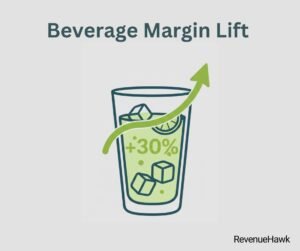
And remember: customer value sensitivity is real. McKinsey’s 2026 restaurant consumer research talks directly about cost pressures and how food away from home has moved versus food at home.
HOW TO MAKE IT LAST
Stability doesn’t come from a one-time fix. It comes from the routine you run every week.
Here’s the checklist mindset we see in high performers:
- Daily: receiving discipline, date labels, par checks, prep yields and waste log that’s actually used
- Weekly: category view, invoice variance review, top-item re-costing and portion proof
- Monthly: menu mix and margin review, vendor meeting, and retraining the two biggest drift stations
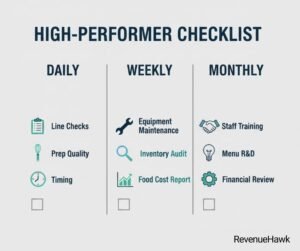
This is where daily inventory habits become your superpower.
Stability is an advantage when the market is under pressure. Black Box data shows the squeeze is real — and that price gaps change demand fast.
THE RESET YOU NEED
Most operators try to save money by cutting quality or cutting staff. That usually creates bigger problems than it solves.
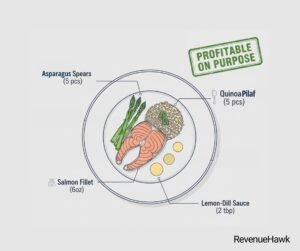
The real play is: design dishes to be profitable on purpose, then run the operation so the math stays true.
Guests stay happy, ingredients stay predictable and you stay in control.
ACTION PLAN: WHAT TO DO NEXT
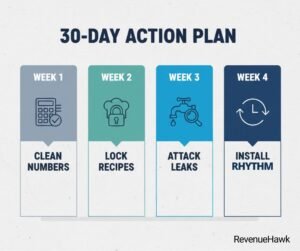
Ready to fix this in 30 days? Here’s the plan: (Week 1) clean your number, (Week 2) lock recipes and portions, (Week 3) attack vendor and menu leaks, and (Week 4) install the rhythm so it doesn’t come back.
How to clean my number?
Run a 15-point weekly audit. Your only goal this week is data you can trust.
These are must-dos and non-negotiable:
- One inventory time
- Clean invoice cutoff
- Category breakdown
- Top 10 variance list (what moved, by how much)
How to lock recipes and portions?
Update recipe costs on your top sellers and install portion tools where the work happens. Don’t expect people to remember. Make it hard to get wrong.
Make one station the hero: grill, sauté, pantry — wherever your high-cost items flow.
How to attack vendor and menu leaks?
Check vendor invoices line by line. Renegotiate where you have leverage. Then re-check your menu pricing and margins.
Use high-margin menu engineering. Make your menu more than marketing — make it a cost-control tool.
How to keep it from coming back?
Schedule a weekly review and treat it like a staffed shift. Keep it on the same day and time each week.
- 15 minutes weekly (GM & chef): numbers, variance and one fix
- 30 minutes monthly: menu, vendor and training drift
FREQUENTLY ASKED QUESTIONS (FAQ)
1) What’s the fastest way to diagnose a sudden food cost spike?
The first thing you should do is split costs by category — proteins, dairy, oils, produce. Spikes almost always show up in one or two categories. Then check invoice variance before you blame waste.
2) Should I raise menu prices immediately when costs spike?
Don’t start with pricing. Start by stopping the leak. Price increases can help, but if your portioning and waste are loose, you’re just charging more to fund the same mess.
3) What if my team refuses scales and portion tools?
This usually isn’t a motivation problem. It’s a setup problem.Make portioning the easy option: keep tools where the work happens, pre-portion in prep, and run fast checks before service. Keep it calm and consistent.
4) What’s the most overlooked profit lever?
Beverages and add-ons. They’re easy to standardize, and small mistakes add up fast. (And they rarely create guest complaints when tightened correctly.)
FINAL THOUGHTS
When we see food cost spike, it’s almost never bad luck. It’s gaps: ordering, prep, portions, waste. Manage those, and the numbers calm down fast.
The plays above work because they’re not tricks. They’re controls. When you build the system, you stop getting surprised.
And zoom out: these plays are just a small part of our Restaurant Growth Engine system — where food cost, labor, menu, marketing, and operations all connect. Fixing food cost in isolation is how restaurants stay busy and broke.
Lastly, if you do need to raise prices, do it with intent and don’t panic. Use smart price-rise psychology so guests feel value, not betrayal.