
We’ve seen restaurants hike prices and get crushed — not because the food got expensive, but because the change felt random. They simply didn’t know how to raise menu prices the right way (without losing customers).
When we look across all the restaurants, a clear pattern keeps repeating: the teams that treat menu pricing like an isolated “once a year headache” get squeezed on margin and traffic. The teams that treat it like part of a full operating system — menu design, cost control, portioning, guest psychology — grow profit even in difficult times and ugly inflation years.
In restaurants that actually win this game, price increases come last, after they’ve learned how to lower restaurant food cost in a structured way. Then, when they finally move prices, it feels logical to guests, not greedy.
RevenueHawk Insight: Across the restaurants we analyzed that raised prices in 2024–2025, locations that first tightened food cost and menu mix saw 2.1x higher profit growth than those that just slapped on 5–8% across the board.
The winners we see almost always do one more thing: they run a weekly food cost audit so they know exactly which dishes can carry a price bump and which ones are already on thin ice.

KEY POINTS: WHAT YOU’LL LEARN
- Step-by-step how to raise menu prices: A simple 6-part pricing tactics system you can run every quarter.
- Why this matters: Why guests are more emotional about “value” now than any time in the last decade — and what big brands are learning the hard way.
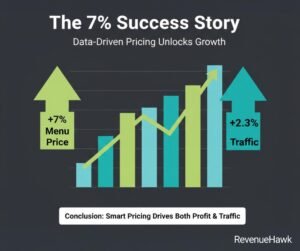
- Case study: How one casual concept raised prices 7% and still increased traffic.
- Key mistakes: The 5 price moves that almost always backfire.
- The numbers that matter: The handful of formulas that should drive every menu price.
- Make it last: How to turn pricing into a repeatable system, not a panic button.
- The reset you need: A new way to think about “expensive” vs “worth it” in your restaurant.
- Action plan: A 30-day play you can start this week.
WHY THIS MATTERS
The latest CPI data reported by the U.S. Bureau of Labor Statistics (BLS) shows “food away from home” prices up 4.1% year-over-year, outpacing overall inflation. That means guests are feeling price pressure everywhere — groceries, gas, rent — before they even open your menu. There’s demand — but it’s brutally competitive, and guests are more value-focused than ever according to a McKinsey report.
Big brands are already living this:
- McDonald’s saw higher menu prices catch up with it when traffic started to slip as guests pushed back on value — according to a report by Food Service News.
- Noodles-like fast casual brands have had to rework menus as consumers’ perception of value shifted faster than their pricing calendars.
Here’s the key miss we constantly see in operators:
- They obsess over “competitors’ prices”
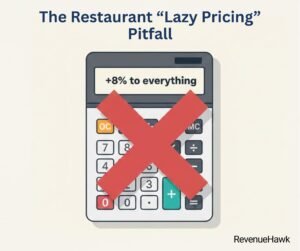
- They make the mistake of raising all menu prices by a flat percentage
- They barely look at accurate recipe costing
- They almost never measure how guests feel about the way prices are shown and framed on the menu
So this isn’t just how to charge more. It’s how to change the way guests see your prices — so higher numbers still feel like a fair trade.
STEP-BY-STEP HOW TO RAISE MENU PRICES WITHOUT LOSING CUSTOMERS
The Pricing Tactics System
To raise prices without losing customers, we advise operators to use the following 6-step pricing system: (Step 1) get your true plate costs, (Step 2) raise where guests are less sensitive
(Step 3) build a price ladder with anchors and tiers, (Step 4) redesign how prices feel on the menu, (Step 5) re-stack portions and bundles, and (Step 6) communicate value.
How Do You Get Your True Plate Costs?
If your costs are wrong, your prices will be wrong. Period.
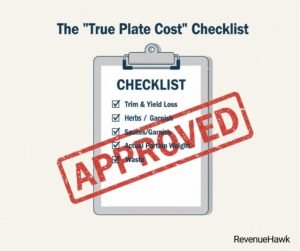
Here’s what “true” means: every dish has a real plate cost that includes trim, yield loss, sauces, garnish, and the portion you actually serve, not the portion you think you serve. If your team free-pours fries and “eyes” proteins, your spreadsheet is fantasy. That’s why you should start with accurate recipe costing.
Pricing psychology doesn’t save bad math. It just delays the pain.
RevenueHawk Insight: In our dataset, restaurants that cost their top 50 items monthly run 3–5 percentage points lower food cost than those that cost “when things feel off.”
How Do You Protect Entry Price Points and Raise Where Guests Are Less Sensitive?
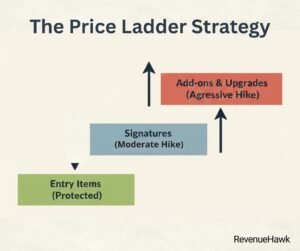
Don’t just raise prices by the same amount on every menu item. The worst move is adding $1 to everything.
Instead protect your entry items (the cheapest burger, the basic tacos, the house pasta). These set your “this place is fair” anchor. Raise prices more aggressively on signature dishes, protein upgrades, and add-ons and modifiers.
Here’s the key: you’re not tricking anyone. You’re pricing the way people already think. When something feels special, they expect it to cost more.
How Do You Make High Prices Feel Normal?
People don’t look at a price and decide. They compare it to what’s next to it.
So, do two things:
- Put a high-priced anchor near your profitable hero dish (e.g., a $38 tomahawk makes a $26 strip feel reasonable).
- Build decoys: items that are intentionally slightly overpriced so your true target looks like the smart choice.
McKinsey calls this part of “revenue growth management” — making sure prices, promotions, and menu layout work together instead of as random decisions. Anchors and decoys are just the restaurant version of that idea.
How Do You Redesign Your Menu So It Sells More?
Don’t use menus that scream, “LOOK AT THE PRICE.” Those menus put prices in a neat right-hand column, use long dotted lines pointing straight at them, and slap dollar signs everywhere.
Instead, do this:
- Put the price right after the item description, in the same font.
- Drop the currency symbol.
- Use clean, simple descriptions that sell taste and occasion — not food-cost math.
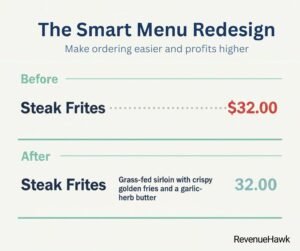
You’re not hiding the price. You’re letting guests read the story first, so their brain anchors on desire, not a number.
How Do You Re-Stack Portions and Bundles (Not Just Prices)?
Instead of “$18 → $22” on a plate that already feels borderline, consider:
- Shrinking the side portion slightly
- Turning it into a bundle with a drink or dessert
- Creating a “for two” sharable version at a higher absolute price but better per-person margin
This is where batch prep systems that lower labor and food waste at the same time quietly support pricing: they give you consistent, predictable builds that make price logic easier.
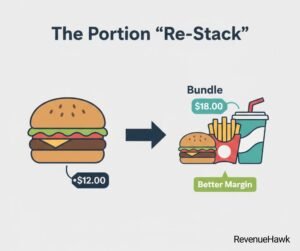
Bundle logic is also where you sneak in small, low-friction price bumps guests barely notice… but your P&L definitely does.
How to Communicate the Value of Your Menu?
You do need to communicate a story. On your menu, on a table topper, or on your site:
- Call out higher quality: “We switched to all-natural wings from X supplier.”
- Explain simple economics: “Our beef costs are up 20%. We’ve increased prices on a few items so we can keep paying our team fairly and keep serving this dish.”
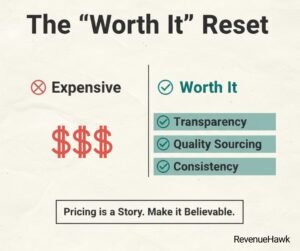
Guests are not reading BLS reports, but if they did, they would see the same 4%+ yearly increases in restaurant prices you’re fighting. Give them a human explanation and your price moves will feel like a partnership, not a money grab.
CASE STUDY: A REAL EXAMPLE
Restaurant Type
Casual full-service grill “Chili’s-type”, American menu
Location
Secondary city, suburban retail center
Seats
120
Problem Identified
Food cost creeping over 33%, servers texting guests about pricey items, traffic starting to soften after inflation bumps.
What Was Implemented
- Costed top 40 items and found 12 dishes under 20% gross margin.
- Installed a tight loss prevention system around waste, theft, and shrink in the bar and grill station.
- Rebuilt the menu layout with anchors and decoys.
- Protected 3 key entry dishes at current prices; raised:
- +6–8% on 12 signature plates
- +10–15% on add-ons and protein upgrades
- Changed language next to higher-priced items to highlight sourcing and portion.
Results (90 Days)
- Average menu price: +7%
- Traffic: +2.3%
- Food cost: down from 33.4% to 28.6%
- Profit per cover: +18%
RevenueHawk Insight: The big unlock wasn’t just the price moves. Once servers understood the new menu logic, add-on attachment rates jumped 11%. That alone covered 40% of the profit lift.
Curious how other places raise prices? Food Institute ranked categories with the fastest-rising menu prices and showed how some brands reframe value instead of hiding from prices.
KEY MISTAKES: WHAT TO AVOID
Here are the pricing moves that we almost always see blow up:
1. Across-the-board increases.
“Everything goes up 7%” is simple… and lazy. Guests notice, especially regulars.
2. Charging more while still guessing at food cost.
If you don’t track weekly food cost in a simple, repeatable way, you’re stacking price on top of chaos.
3. Ignoring hidden food cost killers.
You raise prices, but over-portioning, waste, and comps eat your gain. You must hunt down hidden food cost killers at the same time.
4. Confusing fees instead of clear prices.
Guests are already pushing back hard on random service fees.
5. Thinking more customers automatically means more profit.
A packed dining room can still lose money if the wrong items are too cheap and the right ones never get ordered.
According to YouGov report, only 28% of people think restaurant prices are fair, and many are trading down or ordering less. That’s why you can’t afford to be sloppy with how those prices show up on the page.
METRICS: THE NUMBERS THAT MATTER
If you track nothing else, track these:
Contribution Margin (per dish)
Contribution Margin = Selling Price – Cost per Dish
Gross Margin % (per dish)
Margin % = (Selling Price − Food Cost) / Selling Price
Popularity Index (Sales Mix)
Total number of a specific item sold / Total number of all items sold in that category
Total Weighted Contribution Margin
Contribution Margin x Number of Units Sold
On the beverage side, don’t wing it. See how to calculate beverage cost percentage correctly so your bar isn’t quietly killing margin while you obsess over burger prices.
HOW TO MAKE IT LAST
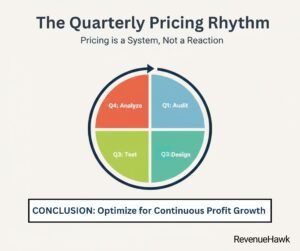
Raising prices once isn’t a strategy. It’s a reaction.
For lasting results you need to create a system:
Daily
Do quick line checks tied to daily inventory habits.
Weekly
Run a simple margin report on your top 20 items.
Monthly
Review POS mix, re-check yields, and refresh your batch prep systems that lower labor and waste at the same time.
Quarterly
Re-run your pricing psychology play:
- Check anchors and decoys
- Protect entry points
- Adjust bundles
- Refresh menu design if needed
THE RESET YOU NEED TO MAKE
You don’t win by grinding your team harder. What we’ve seen over and over is that you win by removing chaos.
Remember this:
- Systems beat talent.
- Numbers beat guessing.
- Consistency beats effort.
Instead of asking, “Can I get away with another 5%?” start asking: “How fast can I fix and prevent sudden food cost spikes — so every price on this menu is backed by clean data and clear logic?”
When you run it this way, price changes aren’t a gamble. They’re the natural result of a system.
For more big-picture context, check McKinsey’s revenue growth playbook for restaurants — it shows how pricing is one ingredient in a larger growth recipe, not the whole dish.
ACTION PLAN: WHAT TO DO NEXT (30-DAY SPRINT)
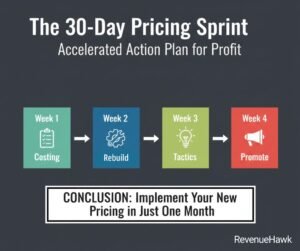
To roll out a price increase safely, execute over the next 30 days as follows: (Week 1) get true costs and identify where price memory is low, (Week 2) kill low-margin losers and rebuild menu, (Week 3) apply key pricing tactics, and (Week 4) tell the story.
How to Get True Menu Data?
- Cost your top 30 items
- Lock recipes and portions
- Run a quick sales mix report
How to Kill and Rebuild Menu?
- Kill low-margin menu losers from your “must move” section
- Sketch a basic menu engineering playbook for layout and anchors
What Menu Pricing Plays to Use?
- Protect entry price points
- Move signatures and upgrades up
- Re-design how prices display
- Add 1–2 bundles
How to Tell the Story and Promote New Menu?
- Train servers on the new menu logic and talking points
- Add one short “why prices changed” explanation online or on-premise
- Start a simple weekly margin check
QSR Magazine’s “Delicate Art of Menu Pricing” is a handy companion while you do this sprint.
FREQUENTLY ASKED QUESTIONS (FAQ)
Q1: How often should I change prices?
At least once a year, ideally twice. But don’t change everything every time. Use your supplier negotiation tactics to lower unit costs in between, so you’re not relying only on price hikes.
Q2: Won’t guests notice even small increases?
Some guests will notice even small increases — and that’s okay. Your job is to make sure they also notice better quality, clearer portions, and a menu that feels fair and easy to understand. When the value is obvious, small increases sting a lot less.
Q3: Should I ever discount instead of raising prices?
Yes — when you’re repositioning a weak item or building traffic in slow dayparts. But discounts without a solid menu margin base are just slow suicide.
Q4: Do I need fancy software to do this?
No. Just a simple spreadsheet, a scale, and a weekly rhythm are enough to start. The important thing is the system, not the tool.
FINAL THOUGHTS
You may be thinking, “Our prices are too low,” and you’re probably right. But remember, if your system is broken, raising prices just makes the leak faster.
You need to:
- Control cost
- Standardize portions
- Design the menu
- Then use psychology to present fair prices in a way guests can accept
That’s where recipe engineering high-profit dishes without sacrificing quality comes in: dishes that are genuinely better for the guest and better for your margin.
RevenueHawk Insight: From what we’ve seen across thousands of locations, the restaurants that win the next 3 years will be the ones that:
- Treat their menu as their main marketing asset (not their Instagram feed).
- Treat pricing as a quarterly operating system (not a once-a-year headache).
- Treat “value” as something they design, not something they hope for.
The plays here are just a small part of our Restaurant Growth Engine system — but if all you did was run these pricing moves correctly, you’d already be ahead of 90% of the market.