

Here’s the pattern we keep seeing at RevenueHawk: Sales are up. Weekends are slammed. Everyone is busier than ever… but profit is low. And the bank account… looks the same.
Across all restaurants we’ve analyzed, about 62% hit this exact wall: revenue grows 10–25%, but profit barely moves or even drops. And even though food cost inflation is still the #1 operational headache according to Restaurant Dive, when we dig into the numbers, it’s almost never “just” a food cost issue, or “just” labor, or “just” rent. It’s a combination of factors — It’s the system.
The winners we see are the operators who ask, “What exactly is broken in the machine?” instead of wondering, “Why aren’t we making more money?”
Knowing your profitability benchmarks and the key levers that move the system is essential to your restaurant’s financial success. When you lay your real numbers against the right benchmarks, the story is usually obvious: the restaurant doesn’t have a sales problem — it has a structure problem. More orders ran through a leaky system.
Profitability is the stated priority for many operators; according to Toast. This article will show you where those leaks usually are, how to find yours, and what to fix first so that every extra dollar of sales actually turns into profit.

KEY POINTS: WHAT YOU’LL LEARN
By the end, you’ll know:
- The high sales, low profit problem — and how to fix it: Fix the system that’s leaking money at multiple points so higher sales finally translate into real profit.
- Why this matters: Big brands stay profitable because they run tight, data-driven systems, and with costs still rising, independents must fix operational leaks before growth makes them “busy but broke.”
- Case study: How profit jumped by fixing menu mix, pricing, labor flow, and table turns — not marketing.
- Key mistakes: Learn what not to do if you don’t want to keep profit leaks in place.
- The profit metrics that matter: Track a small weekly set of numbers to spot leaks and drive real profit decisions.
- How to make it last: The checklist of weekly habits that makes the results stick.
- The Reset you need: The Mindset Shift From Sales Struggles to Scalable Profit
- Action plan: The 30-day cycle that helps your sales turn into real, repeatable profit.
WHY THIS MATTERS TO PROFIT
You should know that big brands already solved this.
- Fast casual giants use data to know exactly how many seconds each order should take.
- Professionally run chains don’t guess their profit; they forecast it.
- Delivery-first brands build menus around margin, not just “what sounds good.”
They’re no better than you. They just run a tighter system. This is happening while diners stay price-conscious; according to McKinsey & Company.
Here’s where most independents make a mistake and get hurt:
- They chase trends instead of tightening operations.
- They add more items to the menu instead of improving the top 20%.
- They run promos to “boost traffic” without checking how those promos affect profit. That shift is also why discounting can backfire if your structure is broken; according to Black Box Intelligence.
- They believe “If the food is good and the place is full, money will follow.”
But as our data keeps screaming: sales and good food doesn’t guarantee restaurant profit. Some of the best-reviewed spots we’ve seen were also the most broke.
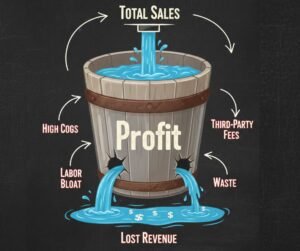
This article matters now because costs aren’t going down — the near-term forecast still points upward; according to USDA Economic Research Service. Food, labor, utilities, rent — none of those are trending in your favor. If your system is even slightly off, growth just makes your problems even bigger.
WHY SALES ARE UP BUT PROFIT ISN’T: STEP-BY-STEP HOW TO FIX IT
Sales can be up while profits stay flat because more orders are flowing through a system that’s leaking money at multiple points. Higher volume often increases food waste and portion drift, exposes underpriced menu “winners” that don’t actually contribute enough margin, and forces extra labor (or overtime) to keep up — especially if the menu is complex and the kitchen or service flow is a bottleneck. On top of that, delivery mix and promos can add revenue while quietly stripping margin once fees, packaging, discounts, and comping are counted. When prime cost (COGS + labor) is already too high, every additional guest can cost you more than they earn you, so the restaurant feels busier and more chaotic, but the bank account doesn’t improve — because the problem isn’t demand, it’s structure.
Here is the simple path we use with operators whose sales are up but profit isn’t.
Step 1: Get Your Real, Not-Pretty Numbers
Stop guessing. You can’t fix what you won’t look at. Go pull your last 3 full months of:
- Total sales (by channel if possible: dine-in, delivery, takeaway).
- COGS split (food, beverage, packaging).
- Labor (front-of-house, back-of-house, management).
- Fixed costs (rent, utilities, insurance, software, etc).
From this, build a basic weekly P&L. You don’t need a fancy software for this — a simple spreadsheet is fine. See, the goal here is not to be perfect; but to be honest.
Step 2: Map the Money Flow
Now, ask five very simple questions:
- How much do we keep after food & beverage costs? (gross profit)
- How much do we keep after labor on top of that? (prime cost)
- Which category is the fattest: food, labor, or fixed?
- Which station or day seems the most chaotic?
- What did we change right before profits flattened? (menu, schedule, hours, delivery mix, promos)
This tells you where exactly to look first: menu, pricing, labor model, or cost structure.
Step 3: Use a simple profit formula
Here’s the core restaurant profitability formula we like operators to live by:
Profit = Sales – (COGS + Labor + Fixed Costs)
That’s it. Every improvement must hit one of those four levers:
- Increase sales per guest (not just guest count).
- Reduce COGS without killing quality.
- Improve labor productivity, not just cut hours.
- Bring fixed costs back in line with reality.
We’ll go deeper on the key metrics in Section 7, but this one formula is the lens. If a decision doesn’t help this equation, it’s decoration, not strategy.
Step 4: Decide What to Fix First (The Sequence Matters)
Our experience and case data show that the most profitable turnarounds usually follow this order:
- Menu & margin – Get rid of items that are popular but low-margin, or operationally heavy
- Labor model & scheduling – Match labor to actual demand patterns, not hopes.
- Cost discipline – Tighten waste and fixed costs once you know what the “right” cost structure should be.
- Throughput & table turns – Make the flow smoother so more revenue fits into the same hours and seats.
- Pricing & positioning – Raise prices where you’re undercharging and bundle to increase average check.
Operators who ignore the sequence usually try to “market their way out” of a broken system — and it almost never works.
CASE STUDY: CASUAL AMERICAN GRILL
Restaurant Type:
Casual full-service American grill
Location:
Secondary city, busy neighborhood
Seats:
82 (60 dining room, 22 bar)
Problem Identified:
Sales up 19% year-over-year. Profit flat. Owners were convinced they had a “marketing issue” and wanted to push more events and ads.
When we ran the numbers through our system, we saw:
- Food cost at 34% (target: 28–30% for their concept)
- Labor at 34% of sales (ok, but not great)
- Prime cost at 68% (too high for their volume)
- Table turns stuck at 1.4x on busy nights (slow)
The big unlock came when we checked their menu mix:
- Best-selling dish: a slow-cook short rib plate with high food cost and heavy labor.
- Lowest-labor items (burgers & bowls) were underpriced and not promoted.
- Bar program had strong margin but weak upsell systems.
We showed them how far off they were from a healthy target profit margin range, and they finally saw their real problem: they were pushing the wrong items, with the wrong pricing, through a slow system.
What Was Implemented to Boost Profit:
Over 90 days, these four big things were done:
- Menu edit:
- Dropped 9 items that were high-complexity, low-margin.
- Tightened portion sizes on their top sellers.
- Re-positioned the menu to highlight high-margin burgers, bowls, and bar snacks.
- Pricing reset:
- Raised prices 6–12% on underpriced items.
- Introduced simple bundles: “Burger + Beer,” “Bowl + Mocktail.”
- Labor and flow:
- Reworked prep lists to match the new menu.
- Adjusted scheduling to reduce overstaffing on slow days and shift more hours to peak times.
- Simplified steps-of-service so servers could handle more tables.
- Table turns:
- Faster fire times with simpler menu.
- Clearer host rules for seating and managing the waitlist.
Results:
- Prime cost dropped from 68% to 61% in 90 days.
- Profit margin went from 4% to 11% at the same sales level.
- When sales later grew another 10%, most of that gain hit the bottom line — not just payroll and food vendors.
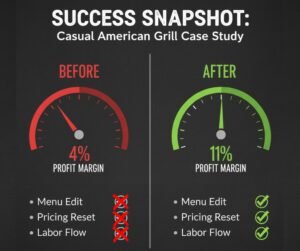
Profit didn’t come from selling harder. It came from fixing the system first.
MISTAKES: WHAT TO AVOID
Here are the main traps we see that keep “busy but broke” restaurants stuck — over and over:
- Trying to grow before fixing margins
More customers just means more of the same leaks. - Confusing revenue with cash
Revenue is vanity. Profit is reality. - Keeping menu items because “people love them”
If they kill your margin or slow the kitchen, they might be some of your worst classic profit margin killers. - Scheduling based on vibes, not data
You need to know sales by hour and day, not just “Fridays are busy.” - Assuming delivery orders are always good
Some delivery-heavy restaurants are actually losing money on every third-party ticket once fees and food costs are real. - Relying on marketing to fix operations
So yes, great marketing can make you busy, but broken operations will make you broke faster. - Not measuring anything weekly
Check the numbers weekly, or the problem grows while you stay “busy.”
If you see yourself in even two of these, it’s time to act and get serious about the system.
PROFIT METRICS: THE NUMBERS THAT MATTER
Here are the core metrics we want owners to understand and track.
Food Cost %
Food Cost % = Food COGS / Food Sales
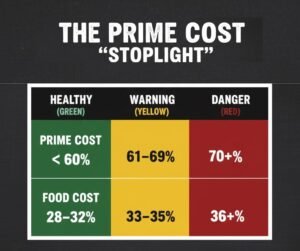
If you’re a casual full-service operator, you typically want this somewhere in the high 20s to low 30s. If your food cost is running too high, you almost certainly have a portioning, pricing, or waste problem.
Labor Productivity
Labor Productivity = Covers / Labor Hours
Instead of asking, “Can we afford payroll?” ask, “How many guests do we serve for every labor hour we pay?” You can improve this by tightening steps-of-service, menu simplicity, and prep.
Contribution Margin (Per Dish)
Contribution Margin = Selling Price – Cost per Dish
Raw dollars of profit per dish matter. Don’t just look at food cost percentage. A 25% food cost on a $10 dish ($7.50 contribution) may be worse than 32% on a $20 dish ($13.60 contribution).
Prime Cost %
Prime Cost % = (COGS + Labor) / Sales
For most full-service restaurants, we want this under 61%. Fast casual and QSR can sometimes push lower due to speed and simplicity. If you’re over 70%, you don’t need more guests — you need less leakage.
Throughput
Throughput = Guests served ÷ (Hours Open × Key Stations)
This tells you how efficiently you’re using your space and team. If your kitchen or bar is a bottleneck, you’re capping your own revenue per hour.
Pick 3–5 of these, track them weekly, and make decisions against them. This is how you optimize the system, so instead of saying, “I think we’re doing okay,” you know exactly what’s working.
LOCK IT IN: YOUR HIGH PROFIT CHECKLIST
Here’s a simple checklist to make sure you’re not just reading — you’re changing.
- I look at a basic weekly P&L, not just the bank balance.
- I know my food cost %, labor %, and prime cost % for last week.
- I can list my top 10 items by profit contribution, not just popularity.
- I have removed at least 3 low-margin, high-complexity items from the menu in the last 3 months.
- My team knows exactly what matters each shift (speed, upsell, table turns, etc.).
- We have clear portion guidelines and we actually follow them.
- We have at least one small project each month focused on cutting operating costs without killing service.
- I know which hours and days we consistently overstaff or understaff.
- We review metrics in a short weekly meeting, not just when something is on fire.
I can assure you that if you can honestly tick even half of these, you’re ahead of most of the market. If you can’t, that’s where your profit is hiding.
THE RESET
This is the mindset change that takes you from stuck to scalable profit:
- You don’t win by working harder — you win by removing chaos.
- You don’t win by serving more people — you win by keeping more from each person.
- Systems beat talent. Your best cook is important, but can’t outwork a broken menu.
- Numbers beat guessing. Your “gut” is useful, but not as a replacement for data.
- Consistency beats big bursts. Getting 5% better each week beats a one-time 50% jump.
See — your restaurant is not a mystery. It’s a machine. Once you see it that way, problems stop feeling personal and start feeling solvable.
ACTION PLAN: WHAT TO DO NEXT TO BOOST PROFIT
Ready to take action and tighten up your restaurant system? Here’s your simple, practical action plan for the next 30 days:
Week 1 – See the Truth
- Pull 3 months of sales, COGS, and labor.
- Build a simple weekly P&L.
- Calculate your food %, labor %, and prime cost %.
- Circle the ugliest number.
Week 2 – Attack the Menu
- Identify the top 20 items by sales.
- Calculate rough contribution margin on each.
- Flag low-margin, high-effort dishes.
- Remove or rework 3–5 of them.
Week 3 – Tune Labor and Flow
- Print your sales by hour and day.
- Adjust schedules where you’re clearly overstaffed or understaffed.
- Fix one bottleneck at a time in your service flow—kitchen, bar, host stand, whatever is slowing you down.
Week 4 – Lock in Tracking
- Pick 3–5 key metrics (from Section 7).
- Set up a simple weekly report.
- Hold a 15-minute “numbers huddle” with your leadership team.
Trust the math, not your gut. Run this cycle for 90 days, and your profit story will change.
FREQUENTLY ASKED QUESTIONS (FAQ)
Q1: My place is slammed on weekends but dead midweek. Should I just market more for weekdays?
Often no — not yet. First make sure weekend volume is actually profitable. If your prime cost is 70%+ on busy nights, fixing that gives you more cash than trying to drag people in on a Tuesday with discounts.
Q2: Do I have to raise prices in order to increase profit? I’m scared of losing guests.
What we see — not always, but quite often — is that many operators are underpriced. A small, smart increase on the right items, paired with better menu design and service, usually lands fine. The goal is to keep guests feeling value while your numbers finally make sense.
Q3: How often should I change my menu?
You don’t need a full rewrite every season, but you should be adjusting at least quarterly: trimming weak items, improving winners, and checking that your key ingredients and margins still work.
Q4: Can marketing still help if my operations are messy?
Don’t mistake traffic for profit. Marketing can bring traffic, but it won’t bring profit by itself. Marketing is gasoline—fix your margins and flow first, then pour on the fuel.
FINAL THOUGHTS
So, you’ve just walked through the real reason why sales can climb while profit refuses to move — and why busy isn’t the cure everyone thinks it is.
Now you know how small shifts in menu, pricing, labor, and throughput can turn the same revenue into very different profit. In our dataset, we’ve watched restaurants jump from 3–5% net profit to 10–15% without adding a single extra seat or extra hour of opening.
But here’s the key: What you’ve read here is just a slice of the full system. Each play works — cutting dead-weight menu items, tuning labor to demand, tightening costs, tracking the right metrics — but they’re all pieces of a bigger system. High-performing restaurants don’t guess which lever to pull. They assess, prioritize, and fix in order.
The operators who win big don’t chase every idea. They commit to one mindset: “I’m going to run my restaurant like a machine, not a mystery.” If your sales are up but profits aren’t, you don’t need more hustle. You need a cleaner system.
Start with your numbers this week. Find the leaks and fix them one by one. Do that for 90 days and your restaurant stops being “busy but broke” — and starts becoming the asset you actually wanted when you opened the doors.