If you treat breakfast like a side project, you’ll get side-project results: empty dining rooms and slow mornings. But if you learn how to promote breakfast like a well-functioning revenue engine — well, you win share, loyalty, and profit before 10 a.m.
What data from 3,500+ U.S. restaurants—from QSR to fine dining—taught us is simple: the restaurants that grow aren’t guessing. That’s true for breakfast, too. They’re running a well-built, repeatable system.
Top performers aren’t chasing trends. They’re using a tight set of revenue drivers that shape how guests see them, what they’re willing to pay, how much they buy, how fast the line moves, and how often people come back. That’s why their growth looks predictable—because it is.
If you want the benchmarks behind what ‘good’ actually looks like, start with our Restaurant Profitability Blueprint.

KEY POINTS: WHAT YOU’LL LEARN
In this article, you’ll learn how to promote breakfast in a way that shows up in your P&L — not just your Instagram.
- The real problem: Most breakfast “promotions” don’t move sales or drive repeat visits. That’s why operators keep losing at breakfast.
- Why it matters: Operators can own a real breakfast position. Breakfast can be a moat that competitors struggle to copy.
- How to promote breakfast the right way: Choose your breakfast role, build hero items people crave, package them into simple offers, and run promos you can repeat every week without chaos.
- Case Study: Turning breakfast from “dead” into a predictable revenue stream
- Mistakes to avoid: Don’t run random specials, don’t discount your way into worse margins, and don’t build offers your team can’t execute fast and consistently.
- Key metrics to use: Track morning covers, repeat visits, attach rate on bundles, speed from order to handoff, and margin per breakfast order.
- How to make results last: The winning checklist
- Action plan: Set your role, launch 1–2 hero items, create two easy bundles, run one repeatable weekly promo, and review the numbers weekly to refine and simplify.
WHY THIS MATTERS
Breakfast isn’t a “nice to have” anymore. It’s a competitive moat. It works best when it’s tied back to the restaurant profitability formula — because breakfast should lift contribution, not just traffic
Look at the brands that own the morning:
- McDonald’s made breakfast the default choice for millions by building the habit (and later reinforcing it with all-day breakfast).
- Starbucks turned coffee + breakfast into a daily ritual with mobile ordering, loyalty, and simple bundles.
- Panera grew early-day sales by pairing clean ingredients with grab-and-go convenience for busy workers.
None of them won with random discounts. They won by owning a clear morning use case in people’s lives.
WHY MOST OPERATORS LOSE AT BREAKFAST
- They announce breakfast like it’s news. News may grab attention temporally but it doesn’t create habits. As explained by Harvard Health Publishing, habits are reinforced through a cue–routine–reward loop—so ‘news’ fades, but repeatable cues and rewards stick.
- They write “New Breakfast Menu!” on a chalkboard… then wonder why traffic doesn’t change.
- They run a two-week discount, get a small bump, then watch it disappear because nothing else changed.
- This last one is a classic success killer. They treat breakfast like extra work for the team — instead of a second business inside the same four walls.
If your main question is:
“How do I promote breakfast?”
sorry to tell you…you’re aiming too low.
The better question is:
“How do I become the obvious morning choice for a specific group of people?”
That’s exactly what this article will help you do.
STEP-BY-STEP: HOW TO PROMOTE BREAKFAST IN A RESTAURANT (THE MORNING DEMAND ENGINE)
We’re breaking this into five plays. You don’t need to run all five right away, but every time you stack another one, your breakfast revenue doesn’t just improve — it compounds. And here’s the truth: these five plays are just the tip of the spear. They’re a tiny fraction of what top brands use to pull in outsized sales and dominate their markets.
If you want your restaurant to become a predictable growth machine — one that produces revenue faster, easier, and cheaper than anything you’re doing now — then Click Here to get the complete Revenue Growth Engine. Stop guessing. Start scaling.
Play 1: Decide What You Want Breakfast to Be
Before you promote anything, you’ll need to define the role of breakfast in your restaurant:
- Are you aiming to be the fast commuter stop? (Speed, grab-and-go, coffee-led)
- The sit-down popular local spot? (Comfort, eggs, pancakes, social)
- The healthy start? (Bowls, smoothies, protein, lifestyle)
- The weekend brunch hero? (Alcohol, social, Instagram moments)
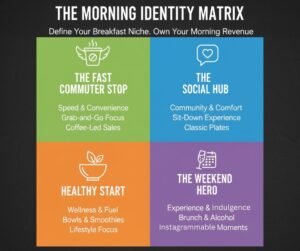
Pick just one primary identity and commit. We’ve seen confused positioning killing promotion more times than we can count. Remember, every offer, image, and message should answer a very simple question: “For who is this? And what problem does it solve in the morning?”
Play 2: Pick 1-3 Breakfast Heroes
A huge breakfast menu doesn’t impress people. It slows you down. You should stop trying to win with options. Try to win with a few “can’t-miss” items. You want 1–3 breakfast heroes that people can name without checking a menu.
Examples
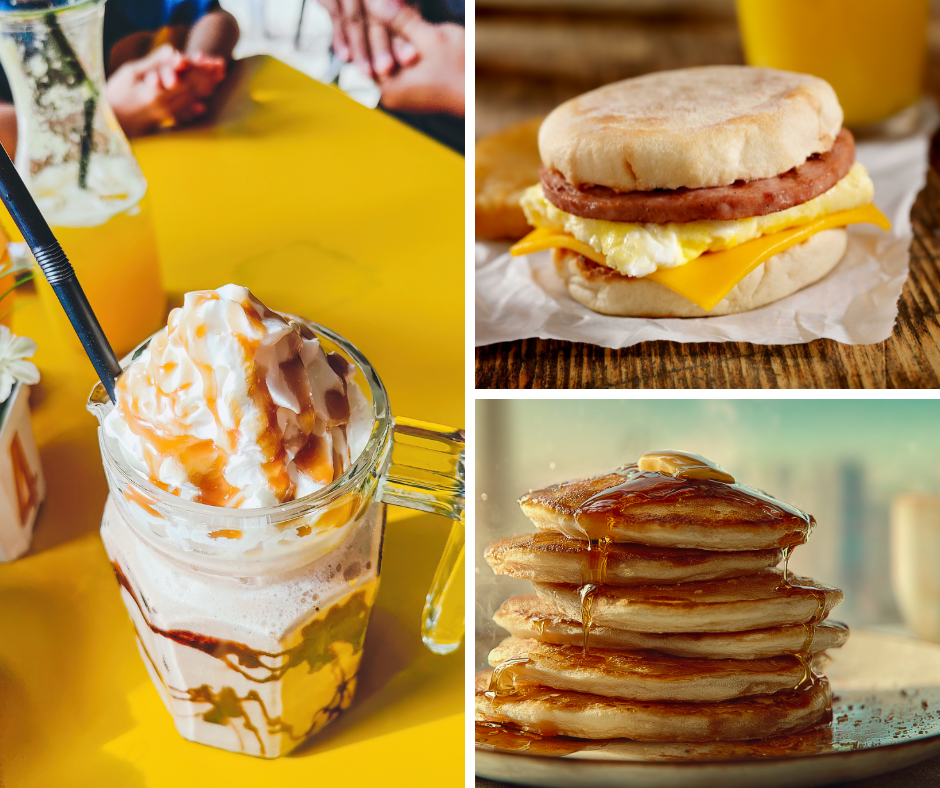
- 5-Minute Power Wrap — protein-packed, handheld, under 500 calories
- Double Stack Pancake Plate — comfort food, big portion, easy yes
- Morning Fuel Bowl — grains + greens + protein, clean “healthy” vibe
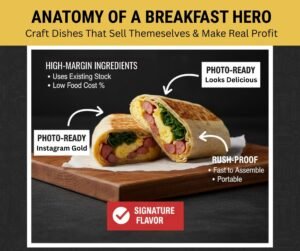
A real hero item
- Uses mostly the same ingredients you already stock
- Has high margin (you’re proud of the profit, not just the taste)
- Is photo-ready (looks like something worth posting)
- Is rush-proof (fast to make, hard to mess up)
Promote the heroes. Build the rest of the menu arround the heroes and let the rest of the menu support them.
Play 3: Breakfast Bundles, Not Random Items
Try to think like a guest. Morning guests don’t think menu…they think like a problem. According to Circana report, convenience dominates morning routines—most breakfasts are prepared in 15 minutes or less, which is why grab-and-go offers and frictionless ordering matter so much:
- “I need coffee + something small.”
- “I need a real meal + a drink.”
- “I just want a pastry and juice.”
So you should stop making them build it. Pre-build it for them.
Here are some bundle ideas we’ve seen working quite well
- Value Commuter Bundle — coffee + breakfast sandwich for one set price
- Healthy Start Bundle — smoothie + protein bowl
- Family Morning Bundle — 2 adult breakfasts + 2 kids’ plates for a clean “round number” price
Why bundles work
According to Harvard Business Review, bundled pricing can increase perceived value and simplify decisions—often without needing heavy discounting.
- They raise check size without feeling pushy (the value is clear)
- They keep your average ticket strong
- They give you simple offers to market (“Get the Commuter Bundle” beats “We have eggs”)
Play 4: Don’t Market a Mess
Many operators don’t understand that if your line breaks at 8:15, marketing won’t save you. It only makes the problem even louder. Fix bottlenecks first. In fact, fixing bottlenecks is one of the fastest ways to reduce operating expenses without hurting service, because you stop paying for friction and start paying for output.
According to QSR Magazine’s 2025 Drive-Thru Report, speed of service is a measurable driver of satisfaction—so fixing bottlenecks before promotion protects the guest experience when volume rises.
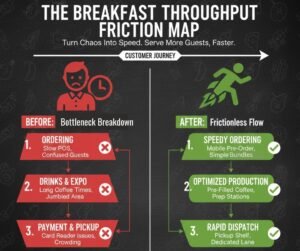
Before promotion, you should do this:
- Trace the full flow: walk in, order, pay, receive and sit/go
- Spot bottlenecks: cashier, coffee, expo, packaging, pickup
- Remove friction fast:
- pre-fill cups during rush
- run a coffee-only lane
- run a pickup-only lane
- pre-portion hero-item ingredients
Here is a handy rule for you
If you can’t serve 2–3x your current breakfast volume smoothly, don’t chase big traffic yet. Fix speed first. Promote second.
Play 5: Own the 1,500-2,500 Feet Radius
Most breakfast money comes from people who pass you every day:
- commuters
- local residents
- office workers
- students
Your job is simple: make it impossible for them to not know you do breakfast.
Low-tech, high-impact moves we see always work:
1) Street visibility
- Big, clean window decal: “Hot Breakfast 7–11 AM”
- Feather flag or sidewalk sign featuring one hero item
- Open/close times readable from across the street
2) Flyers + deals with nearby businesses
- Hand-deliver “Breakfast Cards” to offices, salons, gyms, clinics
- One clear offer: “Show this card for 10% off breakfast this week”
- Add a QR code to join your SMS / loyalty list. To keep SMS promotion clean, CTIA recommends clear opt-in, easy opt-out, and transparent disclosures (frequency, fees, help/stop)—build that into your ‘Breakfast Club’ from day one.
3) Partnerships
- Coffee + coworking spaces
- Breakfast + gym challenge rewards
- Branded breakfast for local events, schools, and sports teams
Before you obsess over social media, win your physical neighborhood. According to Google, local visibility is driven largely by relevance, distance, and prominence—so being the ‘obvious morning choice’ nearby is partly a discoverability game.
CASE STUDY: TURNING BREAKFAST FROM “DEAD” TO “PREDICTABLE” (CHAIN-STYLE PLAYBOOK)
Setup: Fast-casual café, table service
Area: Urban, offices + apartments nearby
Seats: 60 inside, 20 patio
Starting Point
Breakfast was stuck at 4% of sales because:
- People assumed they were lunch-only
- Staff didn’t mention breakfast
- No signature item, no bundles
- Street didn’t scream “breakfast”
The Fix: (System, Not Hype)
Step 1 — Pick a position
They became the Healthy Morning Spot in the area for office and remote workers.
Step 2 — Build heroes + bundles
- Heroes: Protein Power Bowl + Egg & Greens Wrap
- Bundles:
- Coffee + Wrap
- Coffee + Bowl
- Laptop Breakfast (hero + bottomless filter coffee, dine-in)
Step 3 — Win the radius
- Window decal: “Healthy Breakfast 7–11 AM”
- Hand-delivered flyers to 12 offices + 3 gyms
- QR code → Breakfast Club list
Step 4 — Build the habit
- Google listing updated with breakfast photos/hours
- SMS twice a week: one bundle + one reason to come in today
Step 5 — Use time-boxed nudges
- Power Hour 7:30–8:30 with a slightly better bundle price
- Early birds get a free coffee size upgrade (members only)
Outcome
In 12 weeks:
- Breakfast mix jumped to 18%
- Ticket went up from bundles
- Labor improved because mornings finally paid for themselves
- Breakfast customers turned into lunch + weekend regulars
Key Takeaway: they didn’t “run a promo.” They built a breakfast machine.
MISTAKES: WHAT TO AVOID WHEN PROMOTING BREAKFAST
Let’s be blunt. If you’re doing any of this, you’re choking your own breakfast growth. We see these mistakes all the time:
- Big menu on day one
More choices = slower line. Start with heroes. Earn the right to add more. - Marketing “popular” items that don’t pay you
Low margin + discounts equals free labor for you, cheap meals for them. This is exactly why good food doesn’t guarantee restaurant profit — because popularity without margin is just busywork - Thinking Instagram is the lever
Your real power is locals, not random followers. Own the 1,500–2,500 feet around your door. - Letting the line drag
Commuters won’t “wait it out.” They’ll replace you. - Treating breakfast like a one-week campaign
You’re building a routine. Routine takes time. - Not separating breakfast numbers
If you don’t track it, you can’t fix it. Breakfast needs its own scoreboard.
METRICS: THE NUMBERS THAT MATTER FOR BREAKFAST
If you’re serious about promoting breakfast, you need a scoreboard. We’ve seen the best brands track the same few numbers—and they track them like it’s payroll.
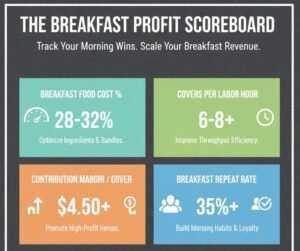
1) Breakfast Food Cost %
Breakfast Food Cost % = Breakfast COGS ÷ Breakfast Food Sales
Keep this at or below your normal target. Never “buy sales” with items that wreck margin.
2) Breakfast Labor Productivity (Covers per Labor Hour)
Covers per Labor Hour = Total Breakfast Covers / Breakfast Labor Hours
If this is low, you’re paying people to stand there.
3) Contribution Margin per Cover
Contribution Margin per Cover = Selling Price − Cost per Dish
Promote what pays you: hero items and bundles. Stop leading with cheap bait. Hospitality research published eCornell notes that menu engineering relies on popularity and contribution margin data to decide what to feature and promote.
4) Breakfast Repeat Rate (Loyalty/POS Tags)
Repeat Rate = Returning Breakfast Guests / Total Breakfast Guests
The goal isn’t one visit. It’s habit.
If you’re unsure what ‘healthy margins’ look like in your segment, use this guide to average restaurant profit margins to sanity-check your targets.
NOW LET’S MAKE IT LAST: HOW TO PROMOTE BREAKFAST CHECKLIST
This is your “are we ready?” list:
- Clear breakfast identity picked (commuter / comfort / healthy / brunch)
- 1–3 hero items that actually profit
- Bundles that make ordering easy and lift check average
- Throughput proven: we can handle 2x volume without chaos
- Neighborhood awareness: signage + offices + gyms + partnerships
- Breakfast KPIs tracked separately and reviewed weekly
Miss more than 2–3? Don’t blame marketing. Go and fix the system first.
ACTION PLAN: WHAT TO DO NEXT (30 DAYS)
If you want a simple starting point, follow this for the next 30 days. Commit to the process, and expect breakfast sales to start climbing fast.
Week 1 — Build the offer
-
- Pick your breakfast identity
- Choose 1–3 hero items and cost them properly
- Create 2–3 bundles with healthy margins
Week 2 — Build the machine
- Fix morning ops and throughput
- Put breakfast on the street (signs, decals, hours visible)
- Hand-deliver “Breakfast Cards” and Flyers to offices, salons, gyms, clinics.
Week 3 — Launch + train
- Run a time-boxed promo (Power Hour / early bird)
- Train staff on talk tracks
Week 4 — Measure + optimize
- Track breakfast metrics daily, review weekly
- Double down on what worked (bundles, times, channels)
- Kill what didn’t — or tweak it and retest
Then refine. Breakfast becomes a predictable revenue pillar, not a wish.
FREQUENTLY ASKED QUESTIONS (FAQ)
Q1: How long does it take to see results?
Most restaurants we work with see a bump in 1–2 weeks once signage and promos are clear. Real, habit-driven growth takes 6–12 weeks. Morning routines change slowly—your system has to stay consistent long enough to stick.
Q2: Do I need a separate breakfast menu?
Not always. What works over and over is clear breakfast offers, not extra pages. A tight breakfast section of 5–10 items with 1–3 hero items + bundles is plenty—especially if it shares ingredients with your main menu.
Q3: Should I discount heavily to get traction?
No. We don’t recommend it. Heavy discounts train cheap customers and crush margin. Use value-based bundles and small, time-boxed perks (like a free coffee size upgrade). Build a habit and a profit center.
Q4: What if my location isn’t great for commuters?
Then don’t chase commuters. Win what you do have: locals, remote workers, weekend brunch. Pick a breakfast identity that matches your traffic, then push hard in that lane.
FINAL THOUGHTS
You now have the breakfast system: Pick a lane. Build heroes. Bundle it. Fix speed. Own the radius. Build the habit. Track the numbers.
That’s how restaurants turn mornings from “dead” into “predictable.”
But don’t miss the point: breakfast is just one piece. We track 16 revenue drivers inside our factor-based profit system. High performers don’t rely on luck or one promo. They identify what’s actually broken — then fix it in order: menu mix, pricing, labor, throughput, demand, dayparts, and more.
If you want the complete Restaurant Growth Engine — plus clear priorities and fast revenue gains — schedule a free consultation below now.