
Most restaurant owners tell us the same thing: “Labor cost is killing me. I need fewer people on the floor.” From what we’ve seen at RevenueHawk, although this could heavily impact restaurant profitability, that’s almost never the real problem.
Across thousands of weekly P&Ls we’ve analyzed, the same pattern keeps showing up:
- Two restaurants with the same sales
- Same city, same wage laws
- One runs 28–30% labor.
- The other is stuck at 38–40%… ironically, with the same headcount.
And the difference isn’t “lazy staff” or the lack of good people. The difference is how clean the operation is. Stations, menu, prep, flow, and scheduling either create labor waste or kill it.
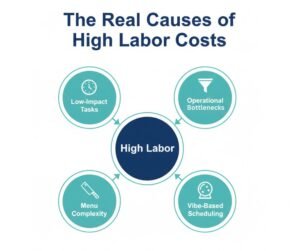
When we dig deeper, we almost always find the same cluster of issues behind “high labor”:
- Too many low-impact tasks
- Bottlenecks at specific stations or time windows
- A menu that demands more labor than the pricing supports
- Scheduling based on vibes instead of hard numbers
The restaurants that win don’t cut staff first. They cut the waste first — and let the numbers tell them if they actually need fewer people later.
This article is about exactly that: how to get rid of labor waste without cutting the people you’ve worked so hard to hire and train.

KEY POINTS: WHAT YOU’LL LEARN FROM THIS ARTICLE
By the time you’re done reading, you’ll understand:
- Step-by-step how to cut labor waste: Use our simple process to cut wasted work so labor falls 4–8 points—without reducing headcount.
- Why this matters: A few labor points can make or break your profit, and cutting the wrong way damages service and your team.
- Real example: See the system fixes that dropped labor from mid-30s to high-20s, improved throughput, and lifted net profit — without staff cuts.
- Key mistakes to avoid: The wrong moves that lock in labor waste and keep you busy without profit.
- The metrics that matter: A small set of labor efficiency numbers will show you exactly where the waste is — and how to stop it.
- Make it last: Use a simple checklist and repeatable habits so labor stays under control and savings don’t disappear.
- The mindset reset you need: Shift from cutting people to fixing the system so labor actually pays you back.
- Action plan: A 7-day sprint that makes labor predictable, controlled, and profitable.
WHY THIS MATTERS (ESPECIALLY RIGHT NOW)
Labor is your biggest single operating expense. Labor is your biggest single operating expense. Recent reports show labor costs trending higher than normal, with many full-service spots running in the mid-30% range. The difference between profitable and struggling operators is often just a few labor points.
At the same time, typical restaurant profit margins are tiny — often just 3–5% at the bottom line. That means a 3–4% swing in labor can literally double your profit.
Leading brands already know this.
- McDonald’s keeps pushing systemwide efficiency and store-level margins through tight operations, tech, and process discipline. For the full operational and cost-risk discussion, see McDonald’s SEC filings.
- Fast-casual brands highlighted in QSR’s annual reports are leaning hard into streamlined menus and order-ahead channels to keep labor productive, not idle.
You can see the pressure on margins and pricing in real time when you read stories of $17 egg sandwiches just to hold a 5% profit margin.
Here’s a key point for you: Most operators obsess over sales, but don’t have a clear average restaurant profit margin target.
It’s very important to understand that if you don’t know your target margin, you can’t know how much labor you can afford. And more importantly, if you don’t know your real labor productivity, you will almost always overpay for the same output.
STEP-BY-STEP: HOW TO CUT LABOR WASTE (WITHOUT CUTTING STAFF)
Step 1: Get Honest Labor Math in Place
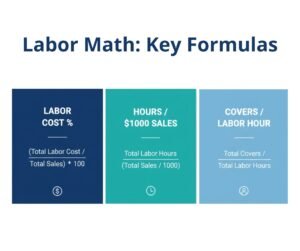
You’ve heard it: “You can’t fix what you don’t measure.” Start by pulling three simple numbers from the last eight weeks:
Labor Cost
Total Labor Cost (wages + payroll taxes + benefits) / Total Sales
For current wage and earnings trend context in the sector, see U.S Bureau of Labor Statistics (BLS).
Labor Hours per $1,000 in Sales
Total Labor Hours / (Sales / 1,000)
Covers per Labor Hour
Total Covers / Total Labor Hours
Run these by day of week and by shift (lunch vs. dinner). That’s where the real story shows up.
You’ll start noticing patterns like:
- Tuesday dinner has decent sales but terrible labor efficiency.
- Saturday brunch looks busy, but your hours per $1,000 in sales are way higher than Friday night.
This is the start of seeing why sales can be up while profits are flat.
Step 2: Map Where the Work Actually Happens
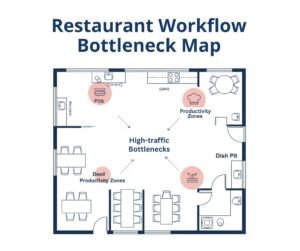
Next, walk the floor during peak and shoulder times with a notepad or simple time-study app. Watch what people are doing minute by minute:
- How many steps does a server walk to grab drinks, POS, and expo?
- How often are cooks waiting on tickets or ingredients?
- How long does one table sit after dessert before payment is handled?
You’ll spot what we call “dead productivity zones,” where people are on the clock but not producing revenue:
- Bottlenecked expo line
- Clunky payment process
- Overly complex plating slowing down the kitchen
Step 3: Cut Complexity Before Heads
In our data, high-labor restaurants almost always share one trait: they try to do too many things for too many types of guests. That shows up as:
- Too many low-volume dishes
- Special prep just for one or two menu items
- Different plateware, sauces, or station setups for items that barely sell
Before even thinking about cutting staff, you should ask:
- Which dishes sell less than 3–5% of total mix but eat a lot of prep time?
- Which steps in the recipe add extra labor but don’t change perceived value for guests?
Consistency here is also how you start cutting operating expenses without hurting service.
Step 4: Redesign Roles, Don’t Just Shrink Shifts
Most owners pull hours out randomly.
- “Let’s take a server off Tuesday.”
- “Cut a cook on slow lunches.”
Instead, you should group tasks into logical “bundles”:
- Guest-facing: greeting, order-taking, payment, check-ins
- Product: cooking, plating, prep, refire handling
- Support: dishes, restocking, cleaning, side work
Then design roles around those bundles with clear outcomes:
- “This role must support X covers per hour while keeping tables turned under Y minutes.”
You’re not trying to have fewer people. You’re trying to have the right person doing the right work at the right time.
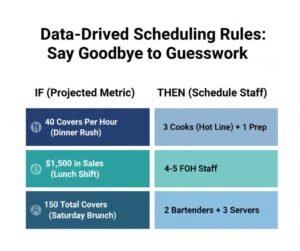
Step 5: You Must Build Scheduling Rules, Not Guesswork
Once roles and numbers are clear, you can build simple rules like:
- “At 40 covers per hour, hot line must have 3 cooks on the line plus 1 prep.”
- “At $1,500 in projected sales for the shift, we schedule 45–50 FOH hours.”
We suggest that you use a rolling 4–8 week average to set these rules, then adjust as your sales trend up or down.
CASE STUDY: A CHIPOTLE-STYLE FAST CASUAL
Restaurant Type: Fast Casual Mexican
Location: Suburban, high-traffic center
Seats: 60 indoor, 20 patio
Problem Identified:
Sales were strong, averaging $85,000 per week, but labor ran at 34–35% every week. The owner felt “we’re slammed, we can’t cut anyone.”
What We Found:
- Line bottleneck at peak — guests stacked up, but back-of-house had idle moments due to poor station setup.
- Overbuilt prep in the morning; staff would “find things to do” between rushes.
- No hard rules tying sales to scheduled hours.
- A few low-volume items that required extra prep and unique ingredients.
What Was Implemented:
- Ran labor math by daypart and found lunch was efficient, but dinner was way out of line.
- Simplified the menu by cutting three low-selling items that drove extra prep.
- Rebuilt line layout so two people could handle burrito/bowl builds at moderate volume, instead of three.
- Shifted 15 hours per week from early prep into the dinner window.
- Set a target labor hours per $1,000 in sales and built scheduling rules to match.
Results (90 Days):
- Labor % dropped from 34–35% to 28–29%.
- No staff cuts — in fact, the team reported feeling less “chaotic.”
- Throughput improved by 18% (more guests served per hour at peak).
- Net profit margin increased by 5%.
You may think you have to be a giant brand to get this kind of result, but you don’t. You just need to treat labor as a math and systems problem — not an emotion problem.
KEY MISTAKES: WHAT TO AVOID
Here are the most common landmines we see when people try to “fix” labor:
1. Cutting staff before cutting chaos
You cut a body from the floor, but your processes are still broken. Service drops, reviews tank, and now your sales fall and your labor % doesn’t move much.
2. Keeping everything on the menu because “a few guests like it”
Low-volume, high-labor dishes are silent killers. Remember, good food alone doesn’t guarantee profit.
3. Scheduling from the gut
“Feels busy, add a server”. “Feels slow, send them home”. That’s not a system. That’s vibes.
4. Letting staff invent their own side work
If you don’t define what “done” looks like for each shift, expect them to fill time with low-value tasks.
5. Assuming more sales will fix bad labor
Many operators assume higher sales will “fix” labor. It won’t. Make no mistake: if your labor system is broken at $50K/week, it will be broken at $80K/week. The zeros get bigger, but the pattern stays the same.
METRICS: THE NUMBERS THAT MATTER
Here are the numbers we watch most closely when we’re solving labor cost waste:
Labor Cost %
Labor Cost % = Total Labor (wages + taxes + benefits) / Total Sales
-
- Full-service restaurants often target low- to mid-30s.
- Quick-service / fast casual often run in the high-20s.
Prime Cost %
Prime Cost % = (COGS + Labor) / Sales
For many concepts, a healthy target is under 60–65%, depending on the model.
Covers per Labor Hour (CPLH)
CPLH = Total Covers / Total Labor Hours
Track this by shift and watch how it moves as you simplify.
Throughput
Throughput = Guests Served per Hour per Station
This is huge in fast casual and busy bars. A small bump in throughput can make the same team produce a lot more revenue.
Contribution Margin per Labor Hour
(Sales – COGS) / Labor Hours
This tells you how much gross profit each hour of labor is producing.
All of this rolls up into the restaurant profitability formula every owner should know: Profit % = (Sales – COGS – Labor – Operating Expenses) / Sales
Once you understand how labor flows through that formula, it becomes a lever, not a headache.
MAKE IT LAST: SIMPLE CHECKLIST
Use this as your quick implementation checklist. Aim to answer “yes” to each item:
- I know my current Labor Cost % by day and shift.
- I track Covers per Labor Hour and hours per $1,000 in sales.
- I’ve run a menu audit and flagged low-volume, high-labor items.
- I’ve mapped out peak flow and identified specific bottlenecks.
- Roles are defined around outcomes, not just titles.
- Scheduling rules are based on sales and covers, not gut feeling.
- Side work is standardized; staff aren’t inventing busywork.
- We review labor metrics at least once per week and adjust.
THE RESET
Here’s the mindset change we see in owners who win this game. They play by these rules:
- You don’t win by squeezing your team. You win by removing chaos.
- Systems beat “rockstar” staff.
- Numbers beat guessing.
- Simpler menus and cleaner flows beat “doing everything for everyone.”
- Labor isn’t just a cost — it’s a multiplier when it’s pointed at the right work.
ACTION PLAN: WHAT TO DO NEXT
Here’s a simple 7-day sprint. Keep it straightforward and execute the steps.
Day 1–2
- Pull 8 weeks of sales and labor data.
- Calculate Labor Cost %, hours per $1,000, and Covers per Labor Hour by shift.
Day 3–4
- Do one focused observation session per key shift.
- Write down exactly where time is being lost.
Day 5
- Run a quick menu and prep audit.
- Mark items that are high-labor, low-volume.
Day 6
- Redesign roles and side work checklists to cut waste.
- Draft simple scheduling rules tied to sales.
Day 7
- Roll changes to one or two shifts (don’t overhaul everything at once).
- Measure the impact on labor % and throughput.
Repeat every 2–4 weeks until your labor line lands where it should. Then keep refining.
FREQUENTLY ASKED QUESTIONS (FAQ)
Q1: What’s a “good” labor % for my restaurant?
It depends on your concept and market, but many full-service spots aim for low- to mid-30s, and fast-casual models often run in the high-20s. Use benchmarks as a guide, but let your own numbers and pricing strategy lead the way.
Q2: Do I have to cut menu items to fix labor?
You don’t have to, but it’s the fastest lever. Even trimming 10–15% of your menu — especially high-labor, low-volume dishes — can take pressure off the kitchen and let you run the same sales with fewer hours.
Q3: Can better tech fix my labor problem?
Tech can help (ordering kiosks, QR ordering, kitchen display systems), but it only works if your underlying system is clean. Tech amplifies whatever system you already have — good or bad.
Q4: How fast should I expect results?
When owners actually implement the steps above, we usually see measurable changes in 4–6 weeks: lower labor % and smoother shifts, without cutting headcount. The bigger, long-term gains come from sticking with the system and iterating.
FINAL THOUGHTS
You’ve just gone through a practical playbook for stripping labor waste out of your restaurant without slashing your team. You’ve seen how a few key moves — clearer numbers, simpler menu and rule-based scheduling — can turn labor from “anchor” into “growth engine.”
But here’s the real game: These are just a few plays from a much larger system. At RevenueHawk, when we look at a restaurant, we don’t see random problems. We see a multi-factor system that explains why one operation hits strong margins with a stable team, while another scrapes by even though it’s just as “busy.”
High-performing restaurants don’t guess which lever to pull. They assess all the key factors (niche, menu, pricing, labor, flow, capacity, demand), prioritize the right sequence of fixes and optimize step by step.
Cutting labor cost waste without cutting staff is one of those moves. Get this right, and you free up cash, protect your culture, and create room to invest in the things that actually grow your restaurant — better people, better product, and better guest experience.
That’s how you stop feeling like your restaurant owns you and start running an operation where every dollar of labor actually works in your favor.