
Walk into any struggling restaurant and you’ll hear the same line: “But everyone says our food is great.” And yet, restaurant profit is still weak.
At RevenueHawk, we’ve heard that sentence in so many restaurant assessments. Some of those “great food” restaurants were printing cash. Others were weeks away from closing. The difference wasn’t the recipes.
What we saw, over and over, is that growing restaurants don’t treat food quality as the main engine of restaurant profit. They treat it as one part of an entire system: positioning, pricing optimization, labor model, menu design, throughput, demand generation, and guest experience all working together.
After styding thousands of restaurants, we built the Restaurant Growth Engine™—a factor-based system that tells you what to do, in what order, to turn your restaurant into a predictable growth machine. When multiple factors score strong together in the system, revenue grows in a way that feels “unfair.” When only food is strong and the rest are weak, you get what we call the “Good Food, Bad Bank Account” pattern.
In this article, we’ll show you 5 reasons why good food doesn’t guarantee restaurant profit — and what actually does. If you want the full framework behind what actually drives cash (benchmarks, scorecards, and the order to fix things), start with our Restaurant Profitability Blueprint. See how your own restaurant scores across the profit drivers top brands use.

KEY POINTS: WHAT YOU’LL LEARN
By the end of this article, you’ll understand:
- The core problem with restaurant profit and how to fix it: Why “people love our food” doesn’t translate into cash in the bank
- Why you should care: Great food alone doesn’t create restaurant profit — only a repeatable system turns demand into reliable cash.
- Case study: System fixes — not recipe changes — that moved the restaurant from survival margins to double-digit profit.
- Key mistakes: Avoid decisions that add chaos, lock in leaks, and keep you busy without building wealth.
- The numbers that actually matter: Tracking the right few metrics makes profit problems visible and fixable.
- How to make results last: Simple, repeatable operating habits turn one-time wins into lasting profit.
- The reset you need to make: Stop running a kitchen mindset and start running a revenue system.
- A simple action plan: Turn “good food” into a real, scalable business.
WHY SHOULD YOU CARE
Here’s the uncomfortable truth that most restaurant operators don’t want to hear: The market does not pay you for “good food.” It pays you for a repeatable system that turns guests into profit.
Look at the brands that dominate:
- McDonald’s doesn’t win awards for best-tasting burger. They win on consistency, speed, and systems.
- Chipotle built a high-margin machine around menu focus, throughput, and line efficiency.
- Chick-fil-A is famous for operations and guest experience, not just a chicken sandwich.
- Starbucks sells an experience, a habit, and a workflow, not just coffee.
Meanwhile, a ton of local operators with much better food are stuck — barely growing and barely staying profitable:
- Full dining rooms, empty bank accounts — and if that describes you, it’s usually a system issue (the real reson why sales are up but profits aren’t)
- High reviews, high stress
- Busy weekends, no cash buffer
Why? Because they try to fix a system problem with food improvements:
- “Let’s add more dishes.” (this kills throughput, complexity explodes)
- “Let’s buy higher-end ingredients.” (food cost spikes, prices don’t follow, low margins)
- “Let’s plate fancier.” (slower kitchen, more labor per cover)
This article matters now because rents are up, wages are up and food costs are up — according to USDA ERS Food Price Outlook. “Good food” is just the starting point. It won’t get you wealthy— sipping cocktails on some island. Profitable systems are what separate winners.
STEP-BY-STEP: 5 REASONS GOOD FOOD DOESN’T GUARANTEE RESTAURANT PROFIT (AND HOW TO FIX EACH ONE)
We’ll walk through 5 reasons your great food might not be turning into money—and what to do about each.
Reason 1: You’re Great for “Everyone” (Which Means No One)
Symptom:
Guests say “the food is great” but you don’t have a clear type of guest who returns over and over.
Pattern we see:
In restaurants we scored low on Factor 1: Key Differentiator/Niche Concept, profit was always volatile. Owners were chasing families, foodies, office workers, date night, and takeout all at the same time.
Good food + fuzzy positioning =
- Confused marketing
- No pricing power
- Inconsistent repeat visits
What you should do instead:
- Pick your “winning guest.”
Example: “Busy office workers at lunch” or “families with kids under 12 at dinner.” - Write one clear promise to that specific “winning guest”:
- “We serve fast, hot, filling lunch in under 12 minutes.”
- “Have stress-free family dinner where your kids will actually finish their food.”
- Align everything to that guest:
- Hours
- Menu size
- Seating layout
- Speed vs experience
When restaurants picked a specific niche or market focus and increased their score from 1 to 3+, we consistently saw 10–18% higher sales per seat without changing a single recipe. Positioning made the food worth much more. For more on what U.S. consumers want, see McKinsey’s 2026 restaurant consumer research.
Reason 2: The Menu Wins Awards, Not Money
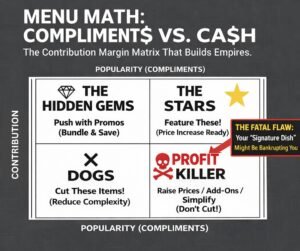
You can’t bank compliments.
We saw this pattern in hundreds of restaurants:
- They had signature dishes guests raved about
- But those dishes had low contribution margin
- The menu mix leaned heavily toward those low-margin items
Key concept:
Profit doesn’t come only from a dish being “best”. It comes from simple menu math: Contribution Margin = Selling Price – Cost per Dish. That’s one piece of the bigger math; here’s the restaurant profitability formula we use to connect menu margin, labor, and overhead into actual take-home profit.
If you sell 1,000 plates of a dish that makes you $3 each, that’s $3,000.
If you sell 700 plates of a dish that makes you $7 each, that’s $4,900. Less volume, but more restaurant profit.
What to do:
- Calculate true cost per dish for your top 20 items.
- Rank them by contribution margin, not just popularity.
- Use Factor 7: Price Level Optimization (Menu Engineering) ideas:
- Highlight your high-margin items on the menu
- Cut or make low-margin “ego dishes” less prominent
- Pair popular low-margin items with high-margin add-ons (sides, drinks, desserts)
In restaurants where we rebalanced just 6–8 menu items, we saw 16–20% profit lift without increasing covers.
Reason 3: Kitchen Throughput Is Your Real Ceiling to Restaurant Profit
Some of the best food we saw came from kitchens that were completely overwhelmed during peak hours.
Common Symptoms We’ve Seen:
- Guests wait 25–40 minutes for food
- Tickets stack up, staff get stressed
- Tables turn slowly
- Takeout is turned off “because the kitchen can’t handle it”
The result? You might have good demand and great food, but your throughput (guests served per hour) is so low that your fixed costs per cover stay high.
We track this under Factor 16: Operational Simplicity.
What to measure:
- Throughput = Guests Served per Hour per Station
- Table turns per peak period
- Max tickets per 15 minutes without quality drop
What you should do:
- Time your line.
Measure how long it takes from order to food at peak. Don’t guess—time it. What gets measured gets fixed. See how according to QSR Magazine restaurants are redefining drive-thru staffing to achieve betters speed. - Cut any menu friction.
- Use fewer prep methods
- Leverage shared base ingredients
- Remove dishes that clog the line (1–2 items can choke the whole system)
- Design for your peak.
- If lunch is your money window, build the whole system so you can crush 11:30–1:30.
Restaurants that lifted their Simplicity score from 1–2 up to 3–4 often saw 12–14% more revenue with the same rent, same kitchen, same staff. The food didn’t change. The system did.
Reason 4: Labor Model Doesn’t Match the Menu
We see this mistake constantly:
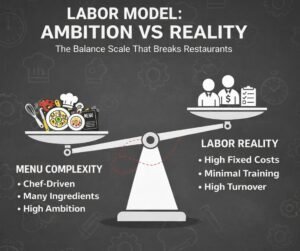
- Owner builds a complex, chef-driven menu
- Then tries to staff it with entry-level wages and minimal training
- Result: slow service, inconsistent quality, high labor cost per dollar of sales. You should always try to reduce operating expenses without hurting service while tightening the model.
Restaurants with high “food ambition” but low level of training almost always have:
- High comp, inconsistent execution
- Owner working insane hours to “hold it together”
What you should do:
- Decide your game and focus:
- If you want high complexity, you need to compensate that with higher prices and stronger training, and can’t ignore labor retention — according to Fast Casual.
- If you want lean, less-qualified labor, you need simpler menu and tighter systems.
- Map tasks per role:
Write down exactly what each role does in a shift, by hour. Remove overlap, remove “mystery tasks.” - Train for one way, not “chef’s mood.”
Standard recipes, standard plating, standard ticket flow.
When restaurants align menu complexity to labor reality, we usually see:
- Labor productivity (covers per labor hour) improves
- Prime cost drops without cutting quality
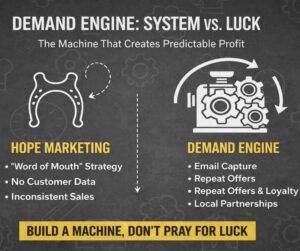
Reason 5: No Demand Engine, Just “Hope Marketing”
Good food is not a marketing strategy.
We’ve seen restaurants where 80–90% of guests rated food 4–5 stars, but:
- They had no email list
- No structured revisit offers
- No clear acquisition channels (it was just “word of mouth”)
So every month felt like starting from zero.
We cover this under Factor 13: Organic Marketing.
What to do:
- Capture guest data:
- WiFi sign-in
- Simple QR for “free dessert on your next visit”
- Online ordering with email capture
- Make 1–2 simple, repeatable offers:
- “Workday Lunch Club” for office crowd
- “Family Night” bundle on slower weeknights
- Run one reliable acquisition channel:
- Local office catering
- Geo-targeted local ads
- Partnerships with gyms, offices, schools
Restaurants that build even a basic demand engine regularly see 5–10%sales growth without changing a thing in the kitchen.
CASE STUDY: “GREAT FOOD, BAD RESTAURANT PROFIT” TURNAROUND
This is a composite case built from multiple clients, modeled on a well-known fast casual taco concept.
Restaurant Type: Fast Casual Tacos (Order at counter, seat yourself)
Location: Urban downtown
Seats: 60
Problem Identified:
- 4.6★ average online rating
- Weekend lines out the door
- But: Owner paid last two months’ rent late and had no cash cushion
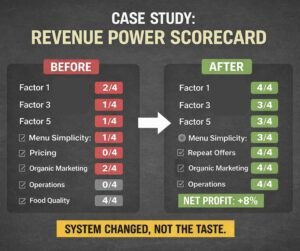
When we ran a Revenue Power Evaluation, here’s what we scored:
- Factor 1 – Key Differentiator / Niche Concept: 2/4
- Factor 3 – Menu Simplicity: 1/4
- Factor 5 – Price Level Optimization: 0/4
- Factor 13 – Organic Marketing: 2/4
- Factor 16 – Operational Simplicity: 2/4
Food quality? 4/4
System? Weak.
What Was Implemented
- Positioning Reset
- Chose clear target: nearby office workers at lunch
- New promise: “Two tacos + drink in under 10 minutes on your lunch break.”
- Menu Simplification & Menu Math
- Cut menu from 32 items to 18
- Removed 4 low-margin “chef flex” dishes
- Standardized ingredients to reduce prep complexity
- Re-priced 6 items to align with contribution margin
- Line & Throughput Fix
- Re-arranged line so toppings and add-ons didn’t slow the main flow
- Added express line for repeats ordering bestsellers
- Redesigned expo station with clearer roles
- Labor & Training
- Created 3 clear role types with simple checklists
- Cross-trained staff for peak lunch vs slower periods
- Implemented 1-page SOPs for each main station
- Simple Demand Engine
- Launched “Lunch in 10 or It’s Free Next Time” offer
- Added QR code on tables: “Join the Lunch Club for a free taco on your next visit”
- Sent 1 email per week with office catering offers and bundle deals
Results (First 90 Days)
- Throughput: +27% guests per lunch hour
- Average check: +11% (via better menu engineering)
- Food cost %: down 3.5 points
- Labor productivity: +22% covers per labor hour
- Net profit: from ~3% to ~11%
The food? Same core recipes. Same chef.
The system changed, not the taste.
KEY MISTAKES: WHAT TO AVOID
There are some common restaurant profit margin killers and patterns we see in “good food, bad profit” restaurants:
- Adding more dishes when profit is low (you add chaos, not cash).
- Keeping low-margin “hero dishes” just because “customers love them,” with no pricing or pairing strategy.
- Scheduling staff by vibes instead of actual productivity numbers.
- Letting staff eyeball portions, then wondering why food cost moves 2–3 points month to month.
- Assuming more customers always equals more profit (not true if your menu and labor are broken).
- Relying on marketing to cover operational leaks instead of fixing throughput, pricing, and menu mix first.
- Believing “if we just win this local award, everything will change.”
Remember, none of these fix the system. They just burn your time and cash.
METRICS: THE RESTAURANT PROFIT NUMBERS THAT MATTER
You can’t manage what you don’t measure. And to know whether your numbers are ‘good’ or ‘dangerous,’ it helps to compare against average restaurant profit margin targets. Here are the core metrics tied to this problem:
Food Cost %
Food Cost % = COGS / Food Sales
Target range will depend on your concept, but big swings month to month are a red flag.
Labor Productivity
Labor Productivity = Covers / Labor Hours
This shows how many guests you serve per hour of labor. High “good food, bad profit” restaurants often have low productivity.
Contribution Margin (Per Dish)
Contribution Margin = Selling Price – Cost per Dish
This is the real profit per plate. High-margin items should be your stars.
Prime Cost %
Prime Cost % = (COGS + Labor) / Sales
This is your “survival number.” If this is too high, nothing else saves you.
Throughput
Throughput = Guests Served per Hour per Station
This tells you if your system can actually handle your demand.
Repeat Visit Rate
Repeat Visit Rate = Returning Guests / Total Guests
Good food helps this, but systems (offers, loyalty, experience) make it predictable.
Track these weekly for 8–12 weeks and you’ll see exactly why “great food” isn’t enough.
HOW TO MAKE IT STICK: THE SIMPLE RESTAURANT PROFIT CHECKLIST
Use this as a quick “Good Food vs Good Business” checklist:
- We can clearly describe our target guest in one sentence.
- Our menu is simple enough that new cooks can learn it fast.
- We know contribution margin for our top 20 items.
- We highlight high-margin items on the menu on purpose.
- We know our Throughput at peak (guests/hour/station).
- We schedule labor based on data, not gut only.
- We have at least one reliable demand channel (email list, loyalty, catering, etc.).
- We review Food Cost %, Prime Cost %, and Labor Productivity every week.
If most of these aren’t a “yes” yet, that’s the gap to close. That’s where the money is. It’s not about better recipes—it’s about better execution.
THE SHIFT YOU NEED TO MAKE
Here’s the mindset change we see in every restaurant that climbs out of the “good food, bad profit” trap:
- You don’t win by cooking harder. You win by reducing chaos.
- Systems beat talent. The best chef in the world can’t save a broken model.
- Numbers beat guessing. Feelings don’t pay suppliers; margins do.
- Consistency beats effort. It’s better to be an 8/10 every day than a 10/10 sometimes and a 5/10 on busy nights.
- You’re not just running a kitchen. You’re running a revenue machine where food is one important part—not the whole thing.
ACTION PLAN: WHAT TO DO NEXT TO BOOST RESTAURANT PROFIT
If you want a simple, no-fluff path, we recommend the following:
-
Pick Your Winning Guest & Promise
Write down exactly who you’re for and what you guarantee.
-
Audit Your Menu Math
- Calculate cost and contribution margin for your top 20 items.
- Highlight and push the profitable, high-margin dishes.
- Quietly reduce the impact of low-margin ego dishes.
-
Measure Throughput & Labor Productivity
- Track guests per hour at peak.
- Track covers per labor hour.
- Remove any menu items or process steps that slow you down.
-
Align Labor to Reality
- Map tasks per role.
- Standardize recipes and plating.
- Train to one consistent way of doing things.
-
Build a Simple Demand Engine
- Start capturing guest data.
- Launch 1–2 simple, repeatable offers.
- Communicate every week, not once a year.
FREQUENTLY ASKED QUESTIONS (FAQ)
Q1: If my food is great, shouldn’t restaurant profit “eventually” follow?
Not always. We’ve seen fantastic food in restaurants that closed. Without solid system in place (market focus, menu math, throughput, labor productivity, and a demand engine), great food just means people are sad when you shut the doors.
Q2: Do I need to lower food quality to be profitable?
No. You usually need to simplify and price correctly, not cheapen. We’ve seen plenty of fixes where the food stayed the same or even improved, the menu got simpler, and the key items got a price bump.
Q3: Should I add more menu items to attract more people?
In most cases, no. A bigger menu usually raises food cost, slows the kitchen, and makes training harder. The most profitable brands focus more, not less.
Q4: I’m afraid to raise prices. Won’t I lose customers?
You might lose some price-only guests, but you’ll keep the right ones and stay alive. When you pair price changes with better experience, clearer promise, and smart menu design, most guests accept it.
FINAL THOUGHTS
You’ve just seen 5 hard reasons why good food doesn’t guarantee restaurant profit — and you’ve seen the fixes pulled straight from our restaurant dataset.
Every pattern in here is real:
- The “everyone is our customer” trap
- The award-winning dish that quietly kills margin
- The kitchen that can’t handle peak demand
- The labor model that doesn’t match menu complexity
- The restaurant that prays for word-of-mouth instead of building a demand engine
Each fix works. But these are just pieces of a bigger picture. They sit inside the full Restaurant Growth Engine™ system that separates restaurants that grow on purpose from restaurants that survive on luck. High performers don’t guess which lever to pull next.
If you’re tired of hearing “your food is amazing” while your bank account disagrees, the next step is simple: schedule a free consultation below now.